



If your enterprise is collecting more data than ever, why does decision-making still feel slower than it should?
That question comes up often in conversations with CEOs and CTOs. On paper, organizations have invested heavily in data platforms, analytics tools, and cloud infrastructure. In practice, leaders still struggle with delayed reports, inconsistent metrics, and AI initiatives that never quite move past pilots.
The issue usually isn’t the volume of data.
It’s how that data is engineered, governed, and delivered across the enterprise.
This is where modern data engineering services for enterprises make the difference—not as a backend function, but as a core business capability.
Why Data Engineering Has Become an Enterprise Priority
Data engineering used to sit quietly behind analytics teams. Today, it directly influences how fast an organization can respond to markets, manage risk, and scale operations.
Enterprises are now dealing with:
- Hundreds of data sources across cloud, SaaS, and legacy systems
- Growing demand for real-time insights
- Rising expectations around data security and compliance
- Pressure to make AI and automation deliver measurable value
Without strong data engineering foundations, even the best analytics or AI tools struggle to perform.
In short, data engineering is no longer optional infrastructure—it’s operational leverage.
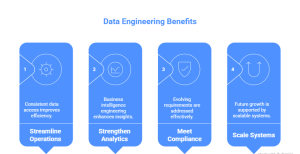
The Biggest Data Engineering Challenges Enterprises Face Today
Fragmented Data Ecosystems
Most large organizations run on a mix of ERP systems, CRMs, industry platforms, and custom applications. Over time, data gets duplicated, transformed differently, and stored in silos.
The result?
Teams spend more time reconciling numbers than acting on them.
When multiple dashboards tell different stories, trust erodes quickly.
Pipelines That Don’t Scale With the Business
Many pipelines were built for yesterday’s workloads. As data volumes grow and real-time needs increase, these systems start to crack—slow processing, frequent failures, and expensive rework become common.
Enterprises often realize too late that their data architecture wasn’t designed for scale.
Data Quality and Reliability Issues
If data quality checks are manual or inconsistent, errors flow downstream unnoticed. Leaders hesitate before relying on reports, and teams revert to spreadsheets or gut instinct.
At that point, data becomes a liability instead of an advantage.
Governance, Security, and Compliance Pressure
Regulatory requirements around data access, privacy, and auditability continue to tighten across industries. Many enterprises struggle to maintain lineage, access controls, and monitoring without slowing teams down.
Fixing governance after systems are built is costly—and risky.
Talent and Ownership Gaps
Experienced data engineers are hard to find and even harder to retain. Internal teams are often stretched thin, maintaining existing systems while trying to modernize at the same time.
Without clear ownership, pipelines become fragile and knowledge stays siloed.
Why Traditional Data Engineering Approaches Fall Short
Point solutions and one-time fixes don’t work at enterprise scale. Tool-first decisions without architectural thinking lead to brittle systems. Treating data engineering as a project instead of a long-term capability creates technical debt that compounds year after year.
Enterprises need strategies that are designed for change, not just for launch.
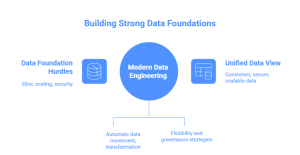
Proven Data Engineering Strategies for Enterprises
Architect for Growth, Not Just Today’s Needs
Modern enterprise data platforms are modular, cloud-native, and loosely coupled. This makes it easier to add new data sources, support new use cases, and scale without constant redesign.
The goal isn’t complexity—it’s resilience.
Use Real-Time Data Where It Actually Adds Value
Not every system needs streaming data, but operational monitoring, customer interactions, logistics, and risk management often do.
A hybrid approach—combining real-time and batch processing—keeps costs in check while delivering speed where it matters.
Embed Data Quality Into the Pipeline
Reliable data doesn’t happen by accident. Automated validation, anomaly detection, and monitoring should be part of the pipeline itself—not an afterthought.
When issues surface early, teams fix them before business decisions are affected.
Make Governance Part of the Architecture
Data access controls, lineage, and audit trails should be built into the platform from day one. When governance is designed in, compliance becomes easier—and teams move faster without added friction.
Align Engineering With Business Outcomes
The most effective data engineering efforts are tied directly to business goals:
- Faster decision cycles
- More accurate forecasting
- Reliable inputs for AI and automation
When pipelines are built with outcomes in mind, data stops being “infrastructure” and starts driving value.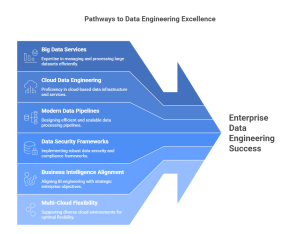
What Enterprises Should Look for in Data Engineering Services
Choosing the right partner matters as much as choosing the right tools.
Enterprise leaders should look for:
- Strong architectural thinking, not just tool expertise
- Experience with regulated and complex environments
- Clear delivery models and transparent communication
- Long-term support, documentation, and knowledge transfer
A good partner doesn’t just modernize your data stack—they help future-proof it.
How Techmango Supports Enterprise Data Engineering
Techmango’s data engineering is approached as a strategic capability, not a support task. We work with enterprises to design and build data platforms that are reliable, scalable, and ready for analytics, automation, and AI.
Our teams focus on:
- Unifying fragmented data ecosystems
- Modernizing pipelines for performance and scale
- Embedding governance and security by design
- Aligning data delivery with real business needs
The objective is simple: help enterprises trust their data and act on it with confidence.
Final Thoughts
If your data systems feel heavy, slow, or hard to trust, that’s not a failure—it’s a signal that your data engineering approach needs to evolve.
Enterprises that invest in strong data foundations move faster, reduce risk, and unlock real value from analytics and AI. Those that don’t often find themselves stuck, despite having plenty of data.
If your organization is reassessing its data strategy, Techmango is ready to help you build data systems that scale with clarity—not complexity.