




If you’re running a growing company in the U.S., you’ve probably looked at HubSpot’s AI and thought:
“Is this enough for us long term?”
Short answer: for scaling teams, it’s a no.
Here’s why.
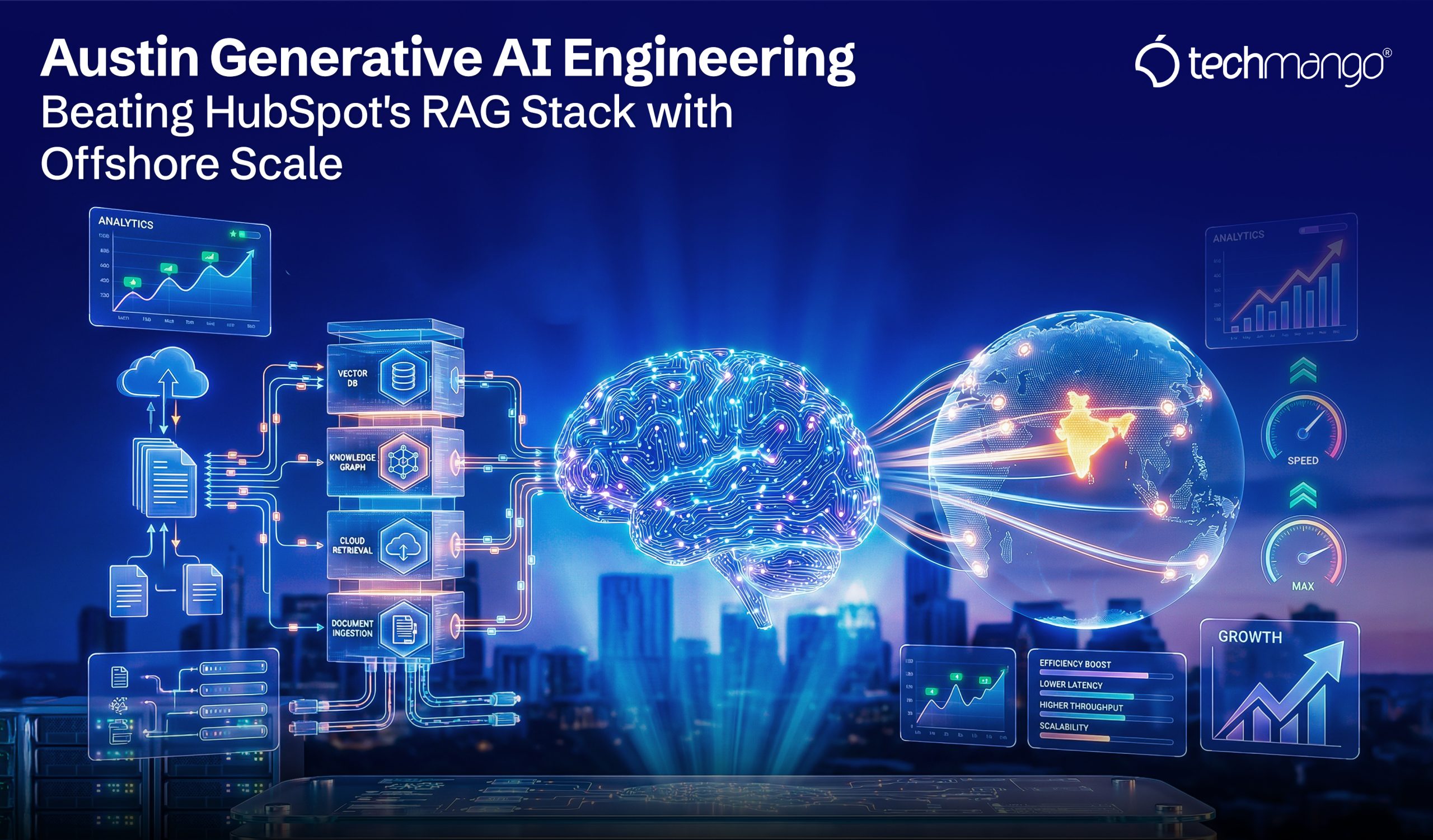
HubSpot uses a RAG (Retrieval-Augmented Generation) stack. It pulls data from stored documents and feeds it into an LLM to generate answers. It works well for general CRM workflows.
But once your data grows, your workflows become complex, and compliance matters? SaaS AI starts to feel restrictive.
According to Gartner, by 2026, 80% of enterprises will use generative AI APIs or custom-built models in production.
Companies are moving from plug-and-play AI to owned AI infrastructure.
Changes in Austin Development Models from Generative AI
Generative AI has shifted how engineering teams operate. Instead of layering AI on top of existing tools, companies are now building retrieval pipelines directly into their backend systems.
In Austin’s growing tech ecosystem, engineering teams are prioritizing infrastructure ownership over SaaS dependency.
AI development services has become part of core system architecture.
How GenAI Transformed Austin’s RAG Engineering Approach
Teams are designing:
- Custom chunking strategies
- Domain-specific embedding logic
- Hybrid retrieval models
- Controlled prompt orchestration
The shift is clear.
Production AI is engineered.
SaaS AI is configured.
That distinction defines long-term scalability.
Custom RAG Engineering
So what’s the alternative?
Build your own RAG system.
Instead of relying on a closed SaaS layer, you control:
- Your vector database
- Your retrieval logic
- Your embedding strategy
- Your LLM orchestration
- Your monitoring pipeline
That level of control matters , especially when response latency, data privacy, and system integration directly affect revenue.
Building this in-house in the U.S. is expensive. Senior AI engineers can cost $160K–$200K per year, and a production-ready RAG stack often requires 3–5 specialists.
That’s where offshore scale changes the equation.
When structured correctly, offshore generative AI engineering reduces build costs by 40–60% while maintaining enterprise-grade quality.
The deciding factor? Architecture before execution.
Reality of HubSpot RAG vs Austin Production Code
HubSpot’s RAG stack is designed for CRM enhancement.
It is not designed to serve as your core AI infrastructure.
As companies scale, they outgrow:
- Limited retrieval customization
- Black-box embedding logic
- Restricted data routing
- SaaS-based latency constraints
- Subscription cost compounding
HubSpot gives you AI as a feature.
Custom RAG gives you AI as an asset.
And assets compound.
Why Austin Teams Outgrow HubSpot RAG Fast
Most teams don’t abandon HubSpot because it fails.
They outgrow it because their use cases evolve faster than SaaS roadmaps.
Once internal knowledge systems span multiple departments, retrieval logic must become customizable.
That’s where black-box SaaS AI becomes restrictive.
Limitations of Traditional Austin Offshore Development
Traditional offshore models fail when teams lack:
- Deep RAG architecture knowledge
- MLOps discipline
- Retrieval optimization experience
- Security alignment with U.S. standards
Without documented AI architecture and evaluation benchmarks, offshore becomes reactive development.
With structure and discipline, offshore becomes scalable engineering.
The difference lies in process maturity , not geography.
What Austin Enterprises Demand from Offshore RAG
U.S. enterprises expect:
- Documented architecture diagrams
- Defined retrieval benchmarks
- Prompt version control
- Latency and hallucination monitoring
- Security alignment with compliance frameworks
Anything less increases long-term risk.
Automation Revolutionizing Austin RAG Development
Modern RAG systems are not built manually.
High-performing AI teams automate:
- Document ingestion pipelines
- Embedding refresh cycles
- Evaluation scoring tests
- Latency tracking
- Monitoring dashboards
Automation ensures consistency at scale.
Human engineering ensures judgment.
Together, they build reliable AI infrastructure.
How Techmango Engineers Master Austin RAG Requirements
This is where Techmango operates differently.
Enterprise RAG systems require:
- Clear retrieval architecture design
- Controlled chunking and embedding strategies
- Hybrid search logic (semantic + keyword)
- Prompt version governance
- Latency and hallucination monitoring
- Security mapping aligned with U.S. compliance standards
Techmango engineers start with architecture workshops , not code.
Only after architecture is locked does execution begin.
Because in enterprise AI, premature coding creates long-term constraints.
Techmango’s Austin RAG Tech Stack
Production-ready RAG systems require more than an LLM API.
A typical deployment includes:
- Vector databases (Pinecone, Weaviate, or similar)
- LLM orchestration layers
- Embedding optimization workflows
- Automated ingestion pipelines
- Evaluation scoring systems
- Monitoring dashboards for latency and accuracy
- Governance controls for data compliance
What matters is not the tools themselves.
It’s how they are integrated.
That integration depth is what SaaS AI cannot replicate.
Conclusion: Building AI as Infrastructure
Can custom offshore RAG outperform HubSpot AI?
Yes , when you need domain-specific tuning, deeper integrations, data ownership, and long-term cost control.
If your roadmap includes:
- Proprietary knowledge systems
- Internal AI copilots
- Cross-department retrieval
- Compliance-sensitive automation
Then custom engineering wins.
HubSpot is a tool.
Custom RAG is infrastructure.
And infrastructure compounds in value.
If you’re evaluating generative AI engineering in Austin, the real question is:
Do we rent intelligence, or build it?
That decision defines your AI maturity.
Offshore scale delivers cost efficiency, but the real advantage comes from combining:
- Architecture discipline
- Automated evaluation pipelines
- Human oversight and calibration
When these elements align, RAG systems become enterprise infrastructure.
Infrastructure drives growth.
You don’t rent intelligence.
You engineer it.
Techmango designs and deploys custom RAG infrastructure for U.S. enterprises that require architectural control, deep system integration, governance alignment, and long-term scalability beyond SaaS constraints.
That is the difference.
And that is how modern AI engineering wins.