




In 2025, the global mobile app market surpasses billions of users who expect fast, reliable, and constantly improving apps. According to industry reports, companies that adopt DevOps practices for custom app development see up to 63% higher software quality and release updates 46 times more often compared to those without DevOps. Moreover, the DevOps market itself is projected to grow to nearly $15 billion by 2028, driven by the increasing demand for automation, faster delivery, and enhanced security. As competition tightens and user expectations rise, DevOps emerges as a critical enabler for delivering superior mobile experiences with speed and scale.
Understanding DevOps in Custom App Development
DevOps merges development and operations into a single automated process that promotes collaboration, continuous integration and delivery (CI/CD), and proactive monitoring. Unlike traditional software development where teams worked in silos with long release cycles, DevOps fosters rapid iteration, frequent releases, and real-time feedback.
Mobile app development faces unique challenges including:
- Device fragmentation: Thousands of device models and OS versions must be supported across Android and iOS ecosystems.
- Frequent updates demanded by users: Apps must release bug fixes and feature enhancements rapidly.
- Security and privacy: Mobile apps handle sensitive user data and need ongoing vulnerability assessment.
- Performance across varying network conditions: Apps should perform seamlessly over 3G, 4G, 5G, and Wi-Fi.
- Backend-frontend integration complexities: Mobile apps interface with cloud APIs, databases, and third-party services that must be robustly managed.
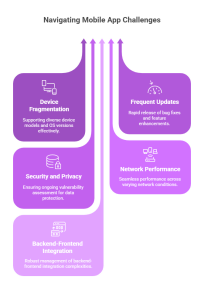
DevOps addresses these complexities by automating testing, deployment, and monitoring, enabling teams to meet the agility and quality demands of modern mobile users.
How DevOps Revolutionizes Custom App Development
1. Accelerates Time-to-Market
By automating build, test, and deployment pipelines, DevOps reduces manual errors and accelerates the frequency of app updates. Companies using mobile DevOps frameworks release updates up to 46 times more frequently and can solve issues 24 times faster than traditional approaches. Faster feedback loops improve responsiveness to user needs and competitive changes.
2. Improves App Quality and Stability
Continuous integration with automated unit, integration, and UI testing helps catch bugs early. Studies show organizations implementing DevOps improved software quality by 63%, notably reducing crashes and compatibility issues. High app stability directly impacts app store ratings—apps maintaining 99.99% uptime average 4.7 stars, whereas apps under 99.00% drop to 4.15 stars on average.
3. Enhances Collaboration Between Teams
DevOps breaks down barriers between development, QA, and operations. Mobile DevOps practices foster shared accountability through cross-functional teams and unified communication channels. This cultural shift drives transparency, faster problem solving, and continuous learning.
4. Manages Device and OS Fragmentation Efficiently
Automated testing platforms integrated into CI/CD pipelines run tests across numerous device types, screen resolutions, and OS versions. This ensures apps function properly on different Android and iOS devices before release, dramatically reducing the risk of user-facing bugs.
5. Boosts Security with Integrated DevSecOps
Security is incorporated throughout the lifecycle with automated static code analysis, vulnerability scanning, and compliance checks. DevOps frameworks enable rapid detection and remediation of security flaws, vital for safeguarding sensitive information handled by mobile apps.
6. Supports Scalability and High Availability
Cloud-native DevOps practices with containerization (Docker) and orchestration (Kubernetes) allow mobile apps backend services to scale dynamically in response to user demand. This ensures consistent performance globally, even during traffic spikes, leveraging edge computing and serverless architectures.
Core DevOps Practices Fueling Mobile App Success
- Continuous Integration (CI): Developers merge code frequently. Automated builds and tests prevent integration bugs.
- Continuous Delivery (CD): Automated release pipelines deploy updates to staging or production quickly and safely.
- Infrastructure as Code (IaC): Tools like Terraform allow backend environments to be provisioned and replicated consistently.
- Automated Testing: Unit, integration, regression, and UI testing on multiple devices and OS versions.
- Monitoring & Feedback: Real-time performance and crash monitoring enable immediate response to user issues.
- Security Automation: Static Application Security Testing (SAST) and Dynamic Application Security Testing (DAST) tools run automatically in pipelines.
Techmango integrates cutting-edge tools and methods in each of these areas, streamlining mobile app delivery and maximizing quality from development to production.
Techmango’s Expert Approach to Mobile DevOps
With most users expecting seamless, instant mobile experiences, Techmango leverages advanced DevOps practices specialized for mobile app development:
- Custom CI/CD pipelines: Tailored for rapid iteration on iOS, Android, and cross-platform environments.
- Automated device testing: Running thousands of tests on real devices and emulators using cloud test farms.
- Security-first workflows: Embedding DevSecOps practices to enforce compliance, privacy, and data protection.
- Cloud and edge optimization: Designing scalable, resilient backend infrastructure with AWS, Google Cloud, and Azure.
- AI-powered monitoring: Using machine learning models to predict and quickly remediate app crashes and bugs.
- Collaborative culture: Aligning developers, QA, and operations through agile methodologies and continuous feedback.
This approach enables Techmango clients to reduce development cycles by half, cut costs by up to 26%, and elevate app quality metrics consistently.
Data-Driven Impact: The Business Case for DevOps in Mobile Apps
- Productivity gains: Companies adopting mobile DevOps report up to 40% increased productivity and 285% ROI.
- Release frequency: DevOps-powered teams release new app builds 200 times more often than their pre-DevOps peers.
- Quality improvement: Automated testing and integration lead to 63% fewer bugs and crashes.
- User satisfaction: Apps with high stability and quick updates achieve significantly better reviews and store rankings.
- Cost control: Automation reduces manual effort and build failures, optimizing CI/CD resource usage and cutting expenses.
- Security compliance: Continuous security checks in pipelines prevent breaches and marketplace removals.
These metrics demonstrate how DevOps is not just a technical enabler but a strategic business investment.
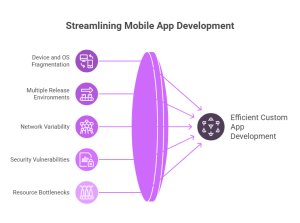
Challenges DevOps Solves for Mobile Development
- Device and OS fragmentation: Vast variety of devices and OS versions create testing nightmare; automated pipelines solve this efficiently.
- Multiple release environments: DevOps tools manage seamless promotion from dev to staging to production with fewer errors.
- Network variability: Automated performance tests simulate 3G/4G/5G and Wi-Fi conditions to ensure app resilience.
- Security vulnerabilities: Continuous scanning and integration of fixes protects user data and brand reputation.
- Resource bottlenecks: Simplified build processes and self-service environments reduce CI/CD time and free developer energy for innovation.
Final Thoughts: Why DevOps is a Must for Custom App Development with Techmango
In the fast-evolving digital landscape of 2025 and beyond, DevOps is essential for mobile app success. It empowers businesses to deliver high-quality, secure, and feature-rich mobile experiences faster and at scale. Beyond technology, DevOps fosters the team collaboration and agility required to respond in real time to user feedback and market changes.
Techmango’s expertise in mobile DevOps brings together deep technical knowledge and a proven delivery model to help companies transform their custom app development. By embracing continuous integration, continuous delivery, automated testing, and security as code, Techmango ensures apps not only launch but thrive in highly competitive environments.
If you want your mobile apps to succeed in 2025 and beyond, partnering with experts like Techmango to implement DevOps is no longer optional—it’s a strategic imperative for growth, quality, and user delight.