



Mobile applications have emerged as the pillar of digital strategy for next-generation enterprises. Across retail and fintech to healthcare and logistics, businesses are counting on apps not only as customer interfaces, but as scalable drivers of efficiency and revenue growth. By 2025, the worldwide app market will reach over $780 billion in revenue, demonstrating that the stakes have never been higher.
In order to remain competitive, IT leaders have to adopt modern custom app development methods that merge technology, methodology, and user-first design. Let’s delve into the mobile app trends 2025 and how they frame solutions for new-age business mobile apps across diverse industries.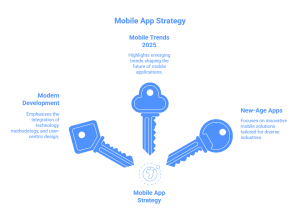
New to mobile development? Start with our breakdown of the top frameworks developers are using today.
What Are the New Technologies Redefining Custom App Development?
How Is AI & ML Revolutionizing App Experiences?
Machine Learning and Artificial Intelligence are no longer in the experimental phase—they’re a part of mobile experiences. AI chatbots, personalized suggestions, and predictive analytics enable apps to respond dynamically to users. For companies like yours, AI makes every interaction intelligent and relevant, boosting engagement and retention.
Why Should Businesses Integrate IoT in Mobile Apps?
The Internet of Things (IoT) has stretched much wider than wearables. Smart homes, smart cars, and health monitoring gadgets are all dependent on apps as their control center. New-age business mobile apps that include IoT offer real-time data, make decisions automatically, and improve operational visibility.
How Are AR & VR Boosting User Engagement?
Virtual and Augmented Reality are moving into usable, ROI-based uses. Retail apps have become available with AR try-on capabilities, and VR is transforming education and employee training. For companies, this isn’t gimmick tech—it’s a proven means of increasing customer confidence and product trust.
What Are Contemporary Development Methodologies?
How Does Agile & DevOps Enhance App Delivery?
Agile and DevOps are now the gold standard for mobile app delivery. Agile guarantees iterative development, quicker feedback, and flexibility in response to changing requirements. DevOps spans development and operations to allow continuous integration and deployment. Both of them cut time-to-market and deployment risks—greatest considerations for companies competing in high-paced industries.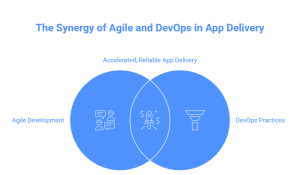
Choosing tools for your app project? Don’t miss our guide on how to select the right tech stack for mobile app development.
What Are Low-Code and No-Code Platforms, and Why Use Them?
Low-code and no-code platforms enable enterprises to prototype rapidly without extensive technical knowledge. Although they’re not an alternative to modern custom app development, they’re a strong solution for experimenting with ideas, creating internal tools, and accelerating go-to-market for straightforward apps.
Which Frameworks and Platforms Are Most Suitable for Contemporary Apps?
Why Use Cross-Platform Frameworks Such as Flutter & React Native?
Platforms such as Flutter and React Native enable companies to develop apps that operate natively on iOS and Android from a single codebase. They reduce development expenses, accelerate delivery, and deliver consistent user experience—without compromising on performance. For CIOs, this means scalability and accelerated ROI.
What Are Progressive Web Apps (PWAs) and Their Benefits?
PWAs merge the accessibility of a website with the functionality of an app. They are lightweight, offline-friendly, and cut out app store downloads. For companies serving multiple markets, PWAs reduce entry points without sacrificing rich experiences.
How Can UX, Analytics & Engagement Drive ROI?
How Can Analytics Help Improve App Performance?
Analytics extends to monitoring downloads. Companies currently track retention rates, feature engagement, and in-app activity to optimize their strategy. Next-generation analytics tools provide predictive analysis, enabling companies to predict churn or the most lucrative features.
Why Gamification Increases Engagement?
Gamification features—leaderboards, challenges, and rewards—harness users’ intrinsic motivations. For new-age business mobile apps, gamification has been found to enhance user stickiness and induce repeat usage, particularly in fitness, e-learning, and retail industries.
How to Achieve Scalability, Security & Future-Proofing?
How to Create Scalable Mobile Apps?
Scalability involves planning for tomorrow’s growth without compromising today’s infrastructure. Cloud-native development, modular design, and microservices make sure that apps scale with business needs.
Security, on the other hand, is a boardroom issue. With data breaches costing firms billions of dollars, processes such as end-to-end encryption, biometric authentication, and adhering to local regulations (like GDPR or India’s DPDP Act) are a non-negotiable.
Future-proofing means embracing frameworks and tools that will not be outdated in two years. Companies investing in mobile app trends 2025—AI, IoT, AR, and predictive analytics—are investing in long-term competitiveness.
Conclusion
The secret to the success of modern custom app development is linking technology with business objectives. Whether it is using AI for personalization, IoT for optimization, or cross-platform frameworks for speedier delivery, the objective is the same: constructing apps that grow, earn trust, and yield quantifiable ROI.
Techmango assists businesses like yours in tackling the intricacies of new-age business mobile apps from choosing the most appropriate frameworks to integrating future-capable features.
👉 Let’s discuss how we can transform your mobile strategy with the latest practices in app development.
Looking to implement these best practices with expert support? Explore our mobile app development services to get started.