



Introduction
Across industries, a significant share of operational friction, cost leakage and innovation delays can be traced back to legacy applications. These systems—built for an earlier era—now limit agility, scalability and responsiveness. They slow down product cycles, complicate security, and prevent organizations from meeting modern customer expectations. As businesses face competitive pressure, cloud expansion and rising regulatory complexity, the modernization of enterprise applications is no longer just a technical upgrade. It is becoming a strategic necessity.
Generative AI introduces a new modernization paradigm. Instead of multi-year replatforming programs or high-risk “rip and replace” efforts, organizations can now automate large parts of refactoring, UI redesign, documentation, testing and cloud preparation. This shift is particularly relevant in 2025, a year marked by maturity in AI tooling, expanding enterprise adoption and rising expectations for digital performance. Companies looking to remain competitive must understand how generative technologies reshape the modernization landscape and what this means for long-term system reliability and operational strength.
What Does Modernization of Enterprise Apps Involve in This Era
Modernization spans far beyond technical fixes. It is a systematic approach to strengthening application value, resilience and usability. This includes:
- Refactoring legacy code into more modular, maintainable architectures
- Migrating monolithic systems into cloud-native or hybrid environments
- Redesigning user interfaces to match current UX standards
- Automating testing, security audits and documentation
- Addressing long-standing technical debt
Traditional strategies—such as lift and shift or full replacement—often fall short. Lift and shift retains outdated logic and inefficiencies, while rip and replace introduces high cost, operational disruption and significant risk. As a result, many business functions remain tied to aging platforms, unable to evolve. Examples include customer-service applications that cannot scale during peak demand or financial reporting systems that hinder real-time decision-making.
Generative AI allows organizations to approach modernization methodically, addressing structural issues without dismantling entire systems. It enhances the longevity and adaptability of critical business applications.
How Generative Technologies Transform Modernization Tasks
What tasks can generative models automate in app modernization
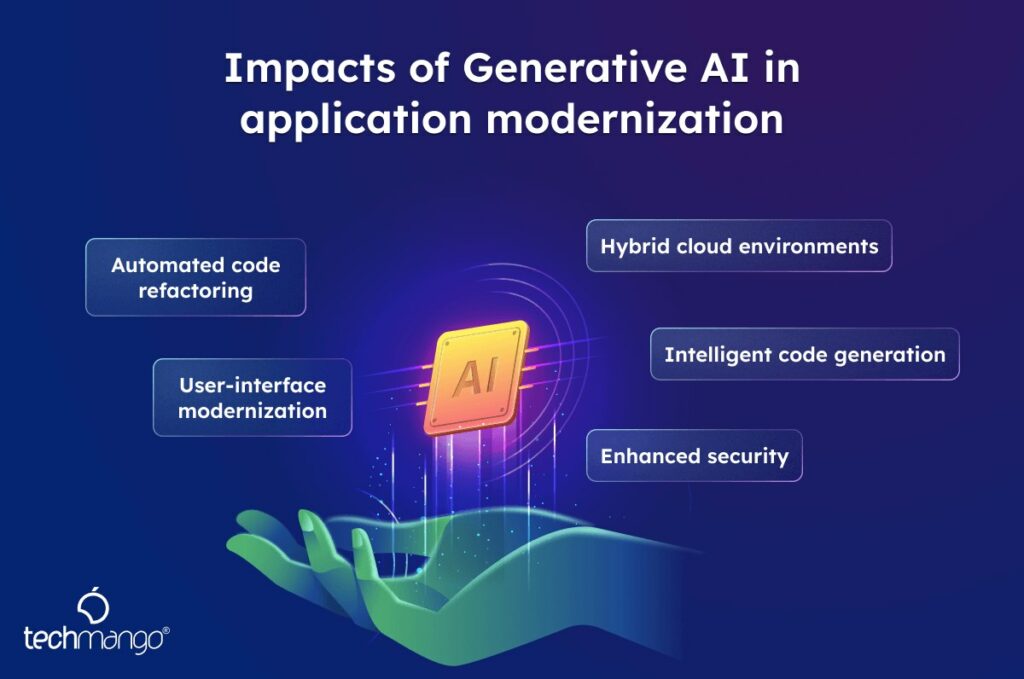
Generative AI introduces automation into areas that were once dependent on large technical teams and prolonged development cycles:
Code review and refactoring
Generative models analyze large codebases, identify anti-patterns, highlight performance bottlenecks and propose optimized structures. They help teams modernize incrementally while retaining functional stability.
UI and UX redesign
AI-generated design frameworks convert outdated screens into modern interfaces aligned with accessibility, usability and brand guidelines.
Cloud and hybrid migration support
Generative models map dependencies across services and components, create migration roadmaps and propose optimal resource allocation for cloud environments.
Security and compliance automation
Legacy applications commonly carry vulnerabilities. AI tools scan code, configurations and integrations to detect risks, misconfigurations and compliance gaps. They then provide remediation steps aligned with industry standards.
Documentation and maintenance
By generating technical documentation, test cases, process flows and error-handling pathways, AI significantly reduces the manual overhead required for long-term system upkeep.
Generative AI is creating a modernization process that is more predictable, measurable and scalable.
Recent Blogs
How Generative AI is reshaping modern businesses?
Why This Matters Now for Business Leaders
How does app modernization impact business outcomes
Modernized applications lead to measurable improvements:
- Faster deployment of new features
- Reduced dependency on legacy specialists
- Increased system uptime
- Lower operational and maintenance costs
- Stronger ability to adapt to regulatory or market changes
These translate directly into improved customer satisfaction, higher workforce productivity and enhanced organizational flexibility.
Which business functions benefit most from modernized apps
High-impact areas include operations, analytics platforms, customer experience portals and core backend systems.
For instance, a company that modernized its customer-service platform observed reduced downtime, improved response speed and a significant drop in operational cost. These outcomes demonstrate how modernization transforms technology from a constraint into a strategic capability.
Key Challenges Enterprises Must Address in 2025
What are the main obstacles in app modernization
Modernization brings several challenges:
Legacy complexity and dependencies
Older applications often have deeply interwoven components, obscure logic and outdated frameworks.
Data migration and integration
Ensuring data accuracy and compatibility with new systems requires rigorous validation and mapping.
Skills gap
Teams may lack expertise in modern development frameworks or generative technologies used in refactoring workflows.
Security and governance
Modernization introduces new interfaces and potential vulnerabilities. Ensuring compliance with industry standards is essential.
ROI clarity
Executives must avoid hype-driven decision-making and focus on measurable modernization impact.
Recommended actions include developing phased roadmaps, running targeted pilots, identifying critical KPIs and establishing structured feedback loops.
How Companies Can Prepare for a Successful Modernization Journey
Organizations preparing for modernization should follow foundational steps:
- Establish clear business objectives beyond technology refreshes
- Conduct a full inventory of the application landscape, dependencies and technical debt
- Select partners with demonstrated expertise in generative automation and modernization frameworks
- Define success metrics across cost, performance, reliability and user experience
- Adopt a continuous improvement mindset, recognizing modernization as a cyclical process
This approach ensures that systems evolve with business needs rather than lag behind them.
Recent Blogs
GenAI in the Software Development process: Revolutionizing the design and development phase
Conclusion
Generative AI is reshaping how enterprises approach application modernization. Instead of slow, costly and disruptive projects, organizations now have access to intelligent tools that automate large parts of the modernization lifecycle. With the right framework, generative-driven modernization transforms legacy systems from operational burdens into strategic assets that support innovation and long-term growth.
Leaders who act now will be better positioned to outpace competitors, reduce risk and create systems built for the digital demands of 2025 and beyond. Techmango’s enterprise application modernization services and generative AI capabilities offer the guidance, technology and execution strength required for this transformation.