



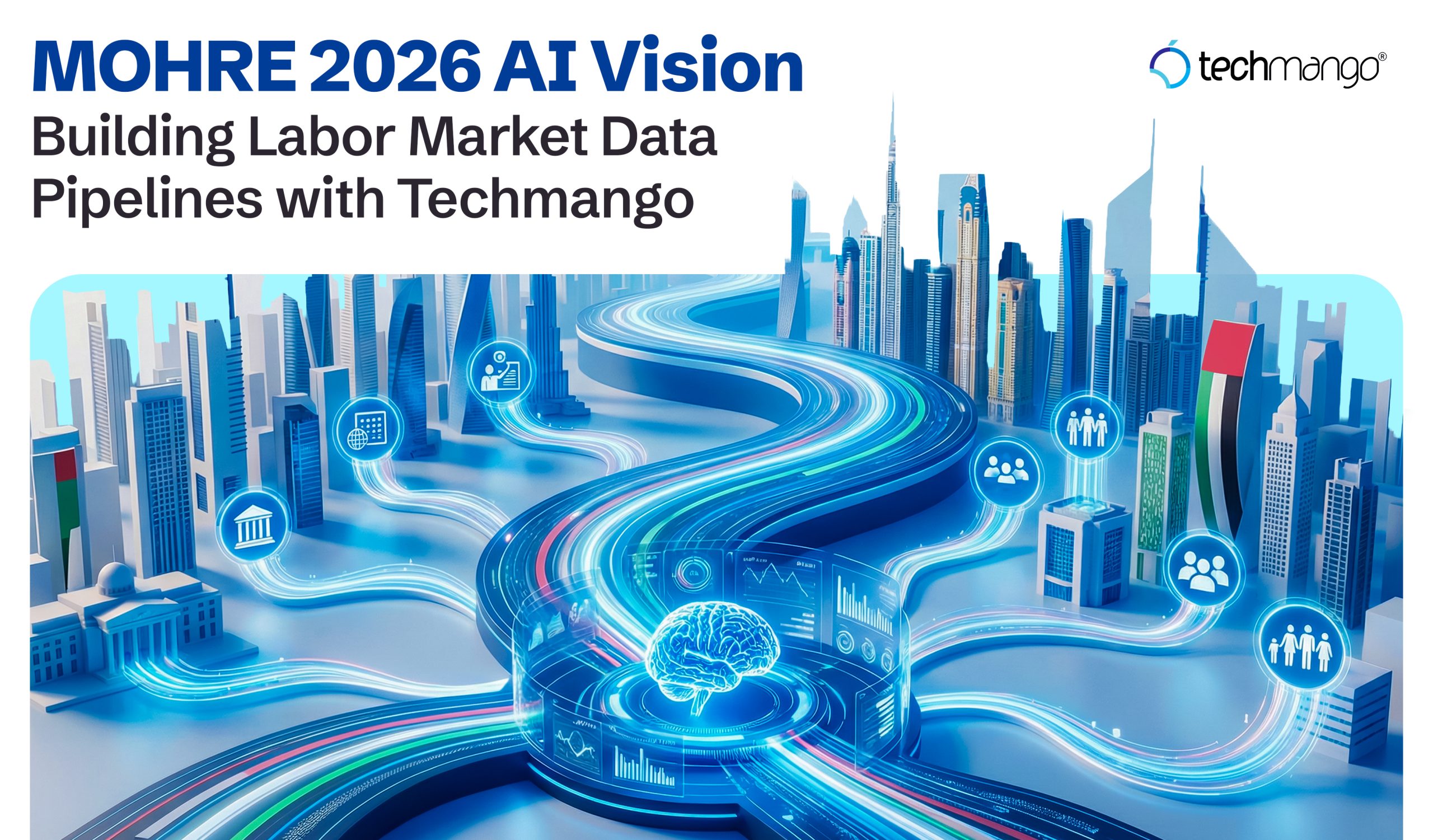
In 2026, enterprise leaders face a clear reality: digital transformation alone is no longer a competitive advantage. Cloud adoption, dashboards, and automation have become baseline expectations. What separates leaders from laggards is predictive intelligence the ability to foresee disruptions, act before failure, and continuously optimize systems at scale.
This shift is visible across industries, most notably in aviation. Global carriers such as Emirates have demonstrated how predictive maintenance powered by real-time data pipelines and advanced AI models can reduce downtime, improve safety, and unlock millions in operational savings. Aircraft no longer wait for faults to occur; systems predict component degradation weeks in advance and trigger automated interventions.
At the same time, governments are adopting the same principles. The Ministry of Human Resources and Emiratisation (MOHRE) has articulated a bold MOHRE 2026 AI Vision, aiming to transform the UAE labor ecosystem through predictive labor market models, AI data engineering, and zero bureaucracy AI automation. This vision positions AI as a national operating layer rather than a collection of isolated tools.
At the intersection of these two worlds aviation-grade reliability and government-scale AI ambition stands Techmango. Techmango operates as a solution builder, translating advanced AI concepts into production-ready systems that deliver measurable outcomes, regulatory confidence, and long-term scalability.
This blog explores how predictive maintenance lessons from aviation apply directly to enterprise and government AI programs, how MOHRE’s 2026 roadmap sets a global benchmark, and why Techmango’s data pipeline–first approach enables organizations to move from intent to impact.
From hangars to ministries: the shared DNA of predictive systems
Predictive maintenance originated in environments where failure is unacceptable. Aviation leaders learned early that reacting to breakdowns is costly, risky, and operationally inefficient. Instead, they invested in continuous data capture, advanced analytics, and decision automation.
Government and large enterprises now face similar pressures albeit in different forms.
|
Aviation Operations |
Government & Enterprise Operations |
|
Aircraft health sensors |
Workforce, compliance, and service data |
|
Maintenance logs & telemetry |
Multi-agency administrative data |
|
Predictive component failure |
Predictive labor market risks |
|
Safety and regulatory oversight |
Policy, privacy, and auditability |
|
Real-time alerts |
Real-time service delivery & compliance |
The lesson is clear: predictive maintenance is not an industry-specific concept, it is a system design philosophy. Whether maintaining aircraft engines or labor market stability, success depends on:
- High-quality, real-time data
- Resilient data pipelines
- Explainable, trustworthy AI models
- Automation aligned with governance
This is the foundation upon which MOHRE’s AI strategy is built and where Techmango delivers differentiated value.
MOHRE’s 2026 AI Transformation Pillars
MOHRE’s roadmap represents a decisive shift from digitization to AI-native governance. Rather than layering AI onto existing systems, the ministry is re-architecting its platforms around predictive intelligence.
1. Full-Scale AI Integration
AI is embedded across the labor ecosystem from employer onboarding and work permits to inspections, dispute resolution, and workforce forecasting. This approach mirrors aviation’s end-to-end predictive maintenance systems, where every subsystem feeds a unified intelligence layer.
For enterprises, this signals a move away from siloed analytics toward enterprise-wide AI platforms powered by shared data pipelines.
2. Zero Bureaucracy & Vision 2030
The principle of zero bureaucracy AI automation aims to eliminate unnecessary manual steps, reduce approval cycles, and increase transparency. In practice, this means:
- Automated decisioning based on predictive signals
- Exception-driven workflows rather than rule-heavy processes
- Continuous service availability
Aviation achieved similar outcomes by automating maintenance scheduling once predictive confidence crossed defined thresholds. MOHRE applies the same logic to labor services preventing issues before they escalate.
3. Predictive Labor Market Models
Instead of responding to labor shortages, compliance risks, or skill mismatches after they occur, MOHRE’s predictive models anticipate trends months in advance. These predictive labor market models enable proactive policy adjustments and targeted interventions.
This mirrors how airlines predict component fatigue patterns based on usage, environment, and historical data.
4. Trusted, Governed Data Platforms
AI without trust fails at scale. MOHRE emphasizes explainability, data lineage, security, and auditability ensuring AI-driven decisions remain transparent and defensible.
For CEOs and CTOs, this underscores a key insight: governance is an enabler of scale, not a constraint.
Why data pipelines power MOHRE’s vision
In every predictive system, aviation or government data pipelines are the real engine. Models change, tools evolve, but pipelines sustain intelligence over time.
Real-time data challenges
MOHRE and large enterprises face complex realities:
- Data distributed across employers, free zones, and agencies
- Inconsistent formats and quality
- High-volume spikes during policy changes
- Strict national and cross-border data regulations
Without robust UAE labor market data pipelines, AI initiatives stall or produce unreliable outcomes.
Predictive analytics needs
To support MOHRE’s ambitions, platforms require:
- Low-latency ingestion (batch + streaming)
- Feature stores for consistent AI inputs
- Continuous model monitoring and drift detection
- Explainable outputs for policy validation
This is where many AI programs fail not due to algorithms, but due to weak data engineering foundations.
Techmango’s data pipeline architecture
Techmango approaches AI as an engineering discipline, not a demo exercise. Its architectures are designed to operate at aviation-grade reliability while meeting government-level compliance standards.
Core architecture components
1. Intelligent Ingestion Layer
Secure APIs, streaming platforms, and change-data capture mechanisms connect diverse data sources without disrupting legacy systems.
2. Unified Processing Layer
Real-time and batch processing converge through cloud-native AI data engineering frameworks, ensuring consistency and scalability.
3. Governed Storage (Lakehouse Model)
Combines analytical performance with cost efficiency, while maintaining lineage, access control, and encryption.
4. AI & MLOps Layer
Feature stores, model training, monitoring, bias detection, and explainability ensure predictive systems remain accurate and trusted.
5. Consumption & Automation Layer
Dashboards, alerts, and APIs power operational workflows and zero bureaucracy automation.
6. Compliance & Security Framework
End-to-end governance aligned with GCC and MOHRE requirements.
The result is a production-ready AI platform that delivers value from day one and scales with regulatory and operational complexity.
Lessons from Emirates aviation leaders applied to enterprise AI
Aviation leaders offer five enduring lessons for predictive AI programs:
- Design for failure, not perfection
Systems must self-heal and degrade gracefully. - Prediction before automation
Automation only delivers value once predictive confidence is established. - Human-in-the-loop governance
Critical decisions remain supervised, ensuring accountability. - Continuous learning
Models adapt as conditions change static AI quickly becomes obsolete. - ROI-driven intelligence
Every predictive model is tied to operational and financial KPIs.
Techmango embeds these principles into every engagement.
6-Week implementation roadmap
Techmango accelerates AI adoption through a structured, outcome-focused approach:
Week 1 – Discovery & Compliance Alignment
Define use cases, success metrics, and regulatory requirements.
Week 2 – Data Pipeline Foundation
Establish ingestion, validation, and quality controls.
Week 3 – Analytics & Feature Engineering
Build predictive features aligned with business outcomes.
Week 4 – AI Operationalization
Deploy models with monitoring, explainability, and alerts.
Week 5 – Integration & Automation
Embed AI insights into workflows and decision systems.
Week 6 – ROI Validation & Scale Strategy
Measure impact and define the enterprise rollout roadmap.
Proven ROI & UAE case metrics
Across government and enterprise engagements, outcomes typically include:
- 30–45% reduction in manual processing effort
- 20–35% improvement in response and compliance speed
- 25%+ operational cost avoidance
- Improved stakeholder trust through transparent AI decisions
Success stories: GCC government client
Using predictive modelling and a controlled pipeline, Techmango helped a GCC government agency modernise their current labour analytics practices. This offered the agency proactive compliance management, quicker approvals and an enhanced ability to deliver uninterrupted service all supported with a fully auditable AI Framework.
Why Techmango is the clear choice for 2026 leaders
- Solution-builder mindset over tool-centric delivery
- Deep AI data engineering expertise
- Regulatory-aligned architectures
- Speed without compromise
- Outcome-driven engagement model
Techmango enables organizations to operationalize AI solutions with confidence, transforming ambition into sustainable advantage.
Final perspective
Predictive maintenance transformed aviation because leaders invested in data-first, AI-ready foundations. MOHRE’s 2026 AI Vision applies the same principle at national scale. With Techmango as a solution builder, enterprises and governments can deploy predictive intelligence that is resilient, compliant, and measurably impactful setting a new standard for AI-led transformation in 2026 and beyond.
People Also Ask Questions
It is a comprehensive strategy to develop an AI-powered future state of predictive labour services, automation and data governance.
By leveraging predictive decision-making, automated workflow, and real-time insights.
Yes, Techmango will build MOHRE-compliant systems with inherent compliance, explainability and security features.
Using AI for data supports operational efficiencies, cost avoidance and proactively supports policy development.
I can securely connect to the UAE Government data via an API, a set of governed secure pipelines and architectures aligned with compliance standards.