



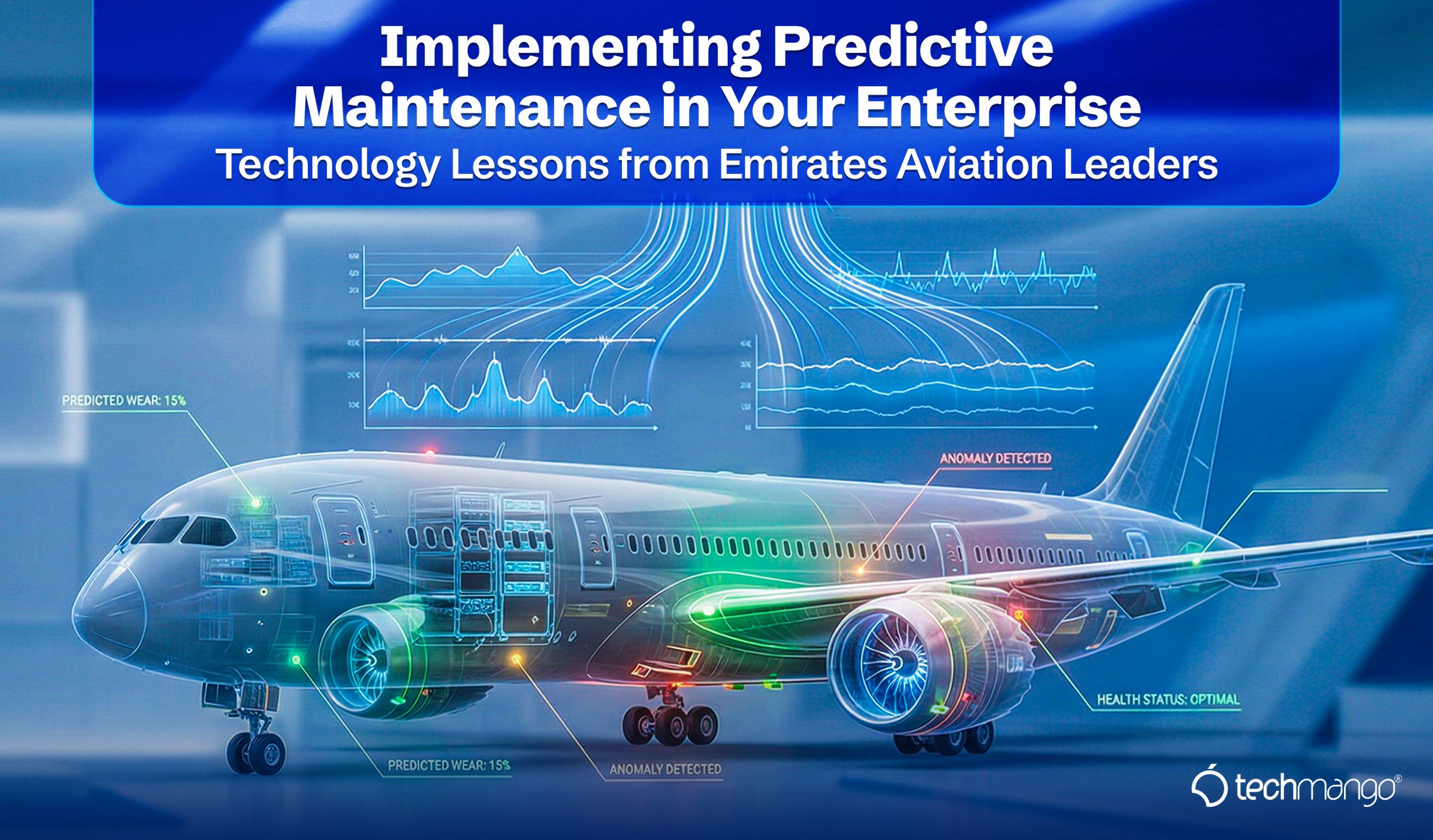
Intro: Emirates’ 30% Downtime Reduction – Your PdM Blueprint
Believe it or not, predictive maintenance has quietly become one of the most powerful competitive weapons in enterprise operations. By 2026, downtime is no longer just an operational issue. It is a balance-sheet problem, a customer trust problem, and a growth problem.
Emirates Engineering proved this at global scale.
By deploying real-time AI-driven monitoring across its A380 and A350 fleets using Airbus Skywise, Emirates reduced unplanned maintenance by more than 30 percent. Aircraft that once waited on reactive inspections now receive predictive alerts before faults impact operations. Maintenance teams fix problems before passengers ever feel them.
US enterprises across manufacturing, logistics, utilities, and energy face the same challenge, just in a different form. Unplanned downtime costs US industry over $50 billion annually in lost productivity, missed SLAs, safety incidents, and emergency repairs. Aging assets, fragmented systems, and manual inspections compound the issue.
The lesson from Emirates is clear. Maintenance does not fail because teams work slowly. It fails because insight arrives too late.
Techmango distills this aviation-grade playbook into a repeatable enterprise model. Combine IIoT sensor intelligence with AI analytics and operational automation, and maintenance shifts from reactive firefighting to predictive supremacy.
Key Stat: Across industries, predictive maintenance delivers 20 to 25 percent maintenance cost savings when implemented correctly.
Emirates Engineering: The Predictive Maintenance Gold Standard
Emirates Engineering is widely regarded as one of the most advanced aviation maintenance organizations in the world. Its predictive maintenance capability did not emerge overnight. It was built through disciplined data integration, AI-driven diagnostics, and operational alignment.
Skywise Fleet Performance+ Implementation
At the core of Emirates’ approach is Airbus Skywise Fleet Performance+, a data platform designed to unify aircraft health data across fleets.
Key capabilities include:
- Real-time health monitoring across 254 Airbus aircraft
Continuous ingestion of aircraft sensor data enables visibility into engines, avionics, cabin systems, and structural components. - Pre-departure automated alerts
AI models identify anomalies before flights, enabling maintenance actions during ground time rather than post-failure events. - ACMS data integration and predictive diagnostics
Aircraft Condition Monitoring System data feeds machine learning models that forecast failure probabilities. - Core X3 analytics dashboard for fleet-wide insights
Engineers access consolidated views of fleet health, risk trends, and maintenance priorities in near real time.
Results Achieved
According to Emirates and Airbus performance data:
- Aircraft on Ground events dropped significantly
- Dispatch reliability improved by 15 to 20 percent
- Turnaround times shortened due to inflight issue prediction
- Maintenance planning shifted from reactive to anticipatory
Why It Works
The success of Emirates’ predictive maintenance lies in a simple principle: Data leads to AI, AI leads to action. No dashboards without decisions. No alerts without workflows. No predictions without execution.
This same principle applies directly to enterprise predictive maintenance.
Core Technologies Behind Enterprise Predictive Maintenance
Predictive maintenance does not depend on a single tool. It depends on an integrated technology stack working in sequence.
Emirates-Validated Technology Stack
Data Flow:
Sensor → Edge → Cloud → ML Model → Maintenance Action
Each layer matters.
- Sensors capture vibration, temperature, pressure, acoustic, and electrical signals
- Edge systems preprocess data and reduce latency
- Cloud platforms aggregate and store high-volume time-series data
- Machine learning models detect anomalies and estimate Remaining Useful Life
- Maintenance systems convert insights into work orders and actions
Techmango engineers this full stack for enterprise environments, ensuring scalability, security, and operational relevance.
The 5-Phase Enterprise PdM Implementation Roadmap
Predictive maintenance succeeds when implemented as a phased transformation, not a technology rollout.
Phase 1: Asset Discovery (Weeks 1 to 4)
This phase defines where predictive maintenance creates immediate value.
Key actions include:
- Criticality ranking
Applying Pareto analysis to identify the 20 percent of assets responsible for 80 percent of downtime cost. - Sensor gap analysis
Evaluating existing instrumentation and identifying where additional sensing delivers ROI. - Baseline MTTR and MTBF metrics
Establishing performance benchmarks to quantify improvement.
Outcome: A focused PdM scope tied directly to business impact.
Phase 2: IIoT Foundation (Months 1 to 2)
This phase builds the data backbone.
Activities include:
- Deploying or integrating IIoT sensors
- Establishing secure edge-to-cloud data pipelines
- Normalizing time-series data across assets
- Ensuring data quality, latency, and availability
Techmango emphasizes interoperability here, avoiding vendor lock-in while enabling future scale.
Outcome: Reliable, real-time asset visibility.
Phase 3: AI Model Development (Months 2 to 4)
AI turns data into foresight.
Key elements:
- Training models on 3 to 6 months of historical data
- Implementing anomaly detection for early warning
- Deploying Remaining Useful Life models for failure forecasting
- Human-in-the-loop validation with maintenance experts
Outcome: Trusted predictions aligned with operational reality.
Phase 4: Operationalization (Month 4 and beyond)
Predictions only matter if they drive action.
This phase focuses on:
- Eliminating alert fatigue through smart thresholds
- Auto-generating work orders in CMMS systems
- Integrating technician mobile apps for real-time execution
- Aligning maintenance schedules with production plans
Outcome: Maintenance becomes proactive and coordinated.
Phase 5: Continuous Optimization
Predictive maintenance improves with time.
Key activities:
- Quarterly model retraining
- Asset performance benchmarking
- ROI tracking dashboards for leadership
- Expansion to additional assets and plants
Outcome: Sustained performance gains and continuous value creation.
Industry ROI: Manufacturing, Energy, Aviation Lessons
Across industries, predictive maintenance delivers consistent results when implemented correctly.
- Manufacturing
Reduced unplanned downtime, improved yield, and stabilized production schedules. - Energy and Utilities
Fewer outages, improved safety, and extended asset lifespans. - Aviation
Higher dispatch reliability, lower maintenance costs, and improved customer experience.
These outcomes translate directly to enterprise competitiveness.
Common PdM Implementation Pitfalls – Avoided
Many predictive maintenance programs fail due to avoidable mistakes.
✅ Do start with 5 to 10 critical assets
❌ Do not attempt to sensor every asset on day one
✅ Do establish cross-functional ownership across operations, IT, and data science
❌ Do not select vendors in isolation
✅ Do run a 12-week proof of value before enterprise rollout
❌ Do not scale unvalidated models
Techmango’s methodology is designed to avoid these traps from the start.
Why US Enterprises Partner with Techmango for Predictive Maintenance
US enterprises partner with Techmango because predictive maintenance success depends on execution depth, operational context, and engineering maturity, not strategy decks or disconnected tools. Techmango operates as a solution builder, translating predictive maintenance theory into production-grade systems that deliver measurable uptime and cost outcomes.
Offshore expertise with aviation-grade rigor
Techmango’s UAE delivery centers operate in close alignment with aviation, energy, and infrastructure ecosystems where downtime tolerance is near zero. This environment has shaped a delivery culture focused on reliability, safety, and precision.
What this means for US enterprises:
- Engineering teams experienced in high-availability systems
- Predictive maintenance models designed for mission-critical assets
- Operational discipline aligned with aviation and regulated industry standards
This aviation-adjacent maturity directly influences how predictive maintenance solutions are engineered, validated, and deployed.
Full-stack predictive maintenance capability under one roof
Predictive maintenance fails when responsibility is fragmented across vendors. Techmango eliminates this risk by owning the entire PdM lifecycle.
End-to-end capabilities include:
- IIoT sensor strategy and data ingestion pipelines
- Edge and cloud data engineering for time-series data
- AI and machine learning model development and validation
- MLOps pipelines for model governance and retraining
- CMMS and ERP integration for automated maintenance execution
By integrating data, intelligence, and operations into a single architecture, Techmango ensures predictions translate directly into action.
Proven delivery across regulated and complex environments
Techmango has delivered 25 plus predictive maintenance implementations across industries where failure has regulatory, safety, and financial consequences.
Key strengths:
- Experience with regulated environments including aviation, healthcare, BFSI, and energy
- Compliance-ready architectures aligned with NIST, ISO, and industry standards
- Human-in-the-loop validation to maintain trust in AI-driven decisions
This experience enables Techmango to deploy predictive maintenance solutions that scale without compromising governance or compliance.
Speed to value with measurable ROI
Traditional consultancies often spend months in analysis before delivering value. Techmango follows a different model.
Delivery advantages include:
- Asset-first prioritization to focus on highest ROI
- Pre-built PdM reference architectures
- Accelerated data onboarding and model development
- Clear KPIs tied to downtime reduction and cost savings
US enterprises typically achieve:
- Up to 3x faster implementation timelines
- First measurable ROI within 90 days
- Sustained maintenance cost reduction over time
Solution builder, not tool reseller
Techmango does not sell platforms, licenses, or point solutions. Tools are selected based on asset needs, data realities, and operational constraints.
Techmango builds:
- Predictive maintenance systems engineered for production
- AI models grounded in real operational behavior
- Workflows embedded into daily maintenance operations
The result is predictive maintenance that functions as a core operational capability, not a pilot program.
Executive takeaway
US enterprises choose Techmango because it delivers predictive maintenance that works in the real world. By combining aviation-grade discipline, full-stack engineering, regulatory fluency, and accelerated execution, Techmango enables organizations to move from reactive maintenance to predictive control with confidence.
Conclusion: Launch Your PdM Transformation
Emirates Engineering proves it. Predictive maintenance is not optional. It is a competitive weapon.
Enterprises that adopt predictive maintenance reduce downtime, control costs, and operate with confidence. Those that delay remain trapped in reactive cycles.
Start with the Skywise blueprint. Execute with Techmango’s offshore precision. Build predictive maintenance that delivers measurable ROI.