
Others

Generative AI is reshaping how businesses think, operate, and grow. From speeding up decision-making to boosting creativity, it is changing every part of modern enterprise strategy. Yet, behind the magic, many organizations still struggle to change the potential of AI into real impact.

At Techmango, we help enterprises overcome these barriers through scalable, ethical, and industry-ready Generative AI services. With 35+ AI projects delivered, 60+ AI experts, and 10+ proprietary frameworks, our goal is to make Generative AI practical, responsible, and aligned with real business results.


What Is Generative AI and Why Are Businesses Using It

What is Generative AI?

Generative AI refers to smart systems that create new content—text, images, voice, or data—by learning from already existing information. It uses Large Language Models (LLMs) and deep neural networks to imitate reasoning, imagination, and the context of understanding. For enterprises, it creates efficiency and automation by making personalized outputs, summaries, and insights that used to need human input.

Key Technologies Behind Generative AI

At its heart, Generative AI uses LLMs such as OpenAI, Mistral, and Falcon, combined with vector databases like Pinecone, Milvus, and Weaviate. Supporting frameworks such as LangChain, Semantic Kernel, and AutoGen power applications like Retrieval-Augmented Generation (RAG), AI chatbots, document understanding, and workflow automation. Together, these parts make adaptive, domain-specific solutions capable of learning over time.

Why is Generative AI Becoming So Popular in Business?

Generative AI is becoming popular because it offers clear improvements in productivity, decision quality, and user experience. Companies use it to customize interactions, summarize complex data, make marketing assets, and automate reporting. Techmango’s projects show that over 85% of AI deployments are now joined with ERP, CRM, and core business systems, showing how quickly enterprises are adopting AI to stay competitive.

Main Challenges Businesses Face with Generative AI

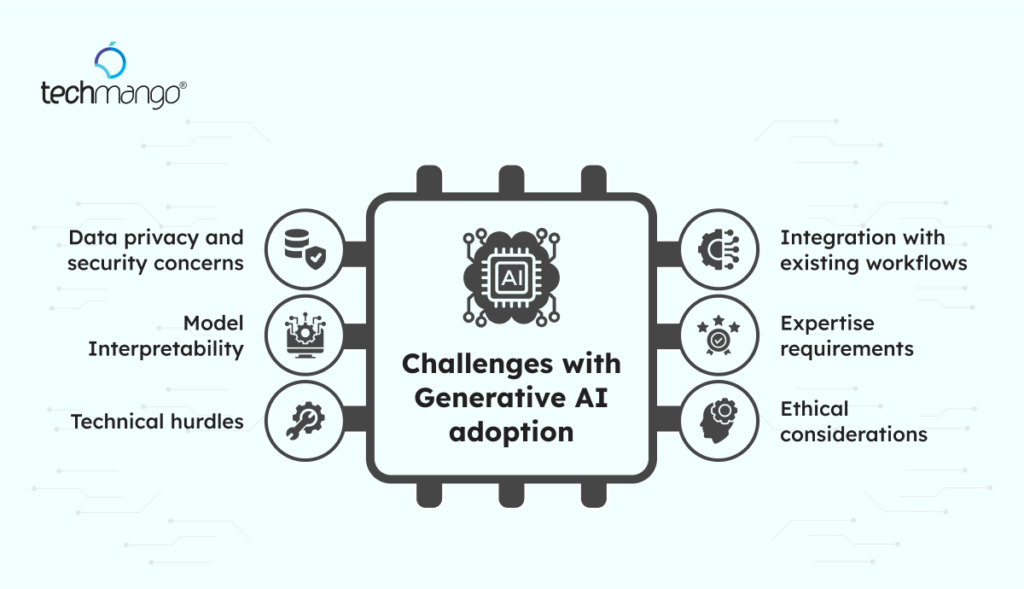
Data Privacy & Security Concerns

The increase of Generative AI raisings the need for strong data rules. Enterprises must keep safe sensitive information and make sure they follow rules like GDPR, HIPAA, and ISO 27001. Poorly managed AI systems run the risk of exposing intellectual property and personal data.

Model Interpretability & Ethical Transparency

Understanding how AI models make predictions stays one of the top worries. Black-box models make uncertainty, especially in industries with rules where auditability and transparency are key. Without explainability, business leaders may wait to deploy AI on a large scale.

Putting Generative AI Into Current Workflow

Adding new AI skills to old infrastructure can be complex. Systems often rely on many APIs, third-party apps, and data silos. When the tools and workflows are not aligned, the full power of AI is not used.

Technical Demands: Data Quality, Compute, Diversity

Generative AI needs diverse, high-quality data sets and scalable infrastructure. Without strong data pipelines or cloud speed, models can drift, which makes results unreliable. Enterprises need automatic data validation and strong compute management to keep AI reliable.

Expertise & Skill Gaps

The global demand for AI experts is still greater than supply. Data scientists, ML engineers, and AI architects are important for development, tuning, and deployment. Many companies face problems in building internal teams that can work with advanced AI work well.

What Ethical Issues Do Businesses Need to Think About?

Bias, false information, and lack of human oversight can affect trust in AI systems. Ethical structures should guide every step—from data sourcing to model evaluation—to prevent unintended problems. Responsible AI use depends on fairness, accountability, and transparency.


Recent Blogs

How does GenAI transform global enterprise standards?


Future Outlook: What’s Next in Generative AI

Multimodal Models & Better Capabilities

The future of Generative AI is in multimodal systems that can handle text, images, video, and speech at the same time. These models allow richer insights and more natural human-AI collaboration, helping teams to do better decisions faster.

What Are the Big Trends for 2025 and Onward?

Upcoming trends include AI copilots, autonomous agents, and domain-specific LLMs working with enterprise data. Cloud providers like AWS, Azure, and GCP are making AI platforms better for safe, scalable deployment. The focus is changing from experiments to making AI work—making sure every AI model is worth real business value with measurable ROI.

Ways to Overcome Challenges & Capture Value

How Can Businesses Overcome Challenges in Generative AI Use?

The first step to success is a clear plan. Organizations need an AI road map that includes readiness checking, model choosing, pilot launching, and ongoing improvement. This orderly method makes sure adoption matches business goals and gives steady results.

Partnering with Experienced AI/ML Providers

Working together speeds up innovation. Working with an experienced provider like Techmango fills skills and infrastructure gaps. Our AI consultants and data scientists make customized GenAI systems—covering everything from custom LLM creation to RAG design and workflow automation—to make sure it is reliable, scalable, and causes measurable impact.

Making Sure it is Ethical and Following Rules

Responsible AI is at the heart of each Techmango project. We use governance rules that include bias warning, model explainability, and audit-ready documentation. This makes sure AI deployments stay following rules, ethical, and trustworthy in regions and industries.

Investing in Data Infrastructure & Quality

Enterprises that prioritize strong data basics produce faster, more reliable outcomes. Strong ETL pipelines, cloud data warehouses, and real-time checking allow high-quality model training and guesswork. Our connections with ERP, CRM, and HRMS systems let companies add intelligence with little trouble.

Making In-House or Outsourcing Strategic Skills

A balanced plan—mixing internal talent with outside skills—gives the best results. Techmango offers proprietary frameworks and accelerators that cut time-to-market, helping companies adopt AI quickly while keeping control and flexibility.

Recent Blogs

What are Techmango’s Gen AI strategies and best practices followed for businesses?
 

Conclusion

Generative AI is more than a technological shift, it’s a chance for business change. By facing issues of data privacy, morals, and adding in, companies can change AI from a concept into a competitive edge.

With 92% client retention and proven success in enterprise-grade AI deployments, Techmango allows organizations to increase with confidence. We provide Generative AI solutions that add intelligence, openness, and governance changing strategy into measurable impact.

Empower your company with Techmango’s Generative AI Services—where new ideas meet responsibility.


Frequently Asked Questions

What is Generative AI, and how does it benefit businesses?

Generative AI uses advanced machine learning models to create new content such as text, images, and music. For businesses, it improves creativity, automates content generation, and enhances customer experiences through personalized marketing, chatbots, and intelligent product design.

What are the major challenges businesses face when adopting Generative AI?

Key challenges include data privacy issues, lack of interpretability, technical complexity, and integration with existing workflows. Businesses must also address ethical concerns such as misinformation and ensure compliance with global data protection laws.

How can businesses overcome data privacy and security issues in Generative AI?

To ensure secure AI adoption, organizations should anonymize training data, follow encryption standards, and comply with privacy regulations like GDPR. Partnering with a trusted AI service provider also ensures robust security measures and ethical data handling.

Why is expertise important for implementing Generative AI successfully?

Generative AI systems require deep technical knowledge for customization, deployment, and maintenance. Businesses lacking internal expertise can overcome this by collaborating with experienced AI development companies or using AI-as-a-Service platforms with pre-trained models.

What is the future of Generative AI in business applications?

The future of Generative AI is promising, with advancements in multimodal AI models that can generate text, images, and videos simultaneously. Businesses will increasingly use it for hyper-personalized marketing, predictive analytics, and intelligent automation across industries.

3 Comments

Leave a Reply

Your email address will not be published. Required fields are marked *

Post comment