



Mobile apps have become the core of how organizations function, interact with customers, and earn money. Behind every successful application, however, is a well-planned architecture. It is the blueprint that decides the way your application acts, grows, and accommodates changing business needs.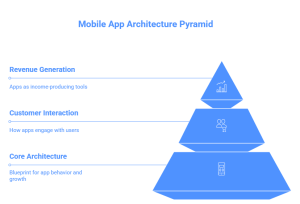
New to mobile architecture? Explore the top mobile app development technologies shaping 2025 to understand what powers modern apps.
2025, bespoke app architecture 2025 does much more than merely creating apps that “work.” It’s about contemporary app architecture that can provide speed, scalability, and security in a fast-changing tech world. For IT leaders, knowing the basics of mobile app architecture is paramount—not only to prevent expensive missteps but also to realize long-term value.
The Essential Elements of Mobile App Architecture
A good mobile app is built on three interrelated layers which work harmoniously with each other:
Presentation Layer: User Interface and User Experience
This is where your customers engage with your app. It encompasses navigation, layouts, and overall user experience. Even the most robust application will depreciate if users experience it as difficult or annoying, hence simplicity and usability are essential.
Business Logic Layer: Application Functionality
Consider this the brain of the app. It establishes workflows, rules, and responses to user input so that the function of the application directly relates to your business processes—be that payment processing, handling health records, or shipping logistics.
Data Layer: Data Management and Storage
This is the performance foundation. It governs how data is stored, retrieved, and safeguarded. In scalable mobile applications, the data layer is responsible for handling increasing data sets effectively while adhering to regulatory requirements like GDPR or HIPAA.
How Mobile App Architectures Are Evolving in 2025
With increasing complexity in business needs, app architectures need to be more adaptive and future-proofed.
Cloud-Native Architectures for Scalability
Cloud-native applications enable apps to automatically scale during traffic spikes, minimizing downtime and infrastructure expenses. For instance, online stores can manage holiday sales spikes without performance loss.
Microservices for Increased Flexibility
Rather than constructing a single large, monolithic application, apps are now built as tiny, standalone services. This renders new app architecture significantly more flexible, enabling IT teams to update or replace a specific feature without interfering with the overall application.
Cross-Platform Development Frameworks
With technologies such as Flutter, React Native, and .NET MAUI maturing, companies no longer require distinct iOS and Android development teams. Such technologies simplify development, cut costs, and provide unified performance across platforms.
Mobile App Architecture Design Best Practices
Modular Design Principles
Distribution of features into smaller, plug-in modules enhances maintainability. As the business continues to grow, the app can be changed without having to rebuild it from the ground up.
Built-In Security and Data Privacy
Security needs to be built-in from day one. Encryption, multi-factor authentication, and secure APIs are best practices in custom app architecture 2025. “Zero-trust” models are also being used by many organizations to protect sensitive data.
Continuous Integration and Delivery (CI/CD)
Regular updates keep apps safe and competitive. With CI/CD pipelines, companies are able to quickly test, deploy, and release updates, limiting downtime and enhancing customer satisfaction.
The Impact of Emerging Technologies
Artificial Intelligence and Machine Learning
AI is revolutionizing apps with personalized suggestions, predictive insights, and smart chatbots. In fintech, for instance, machine learning algorithms are already applied for real-time fraud prevention.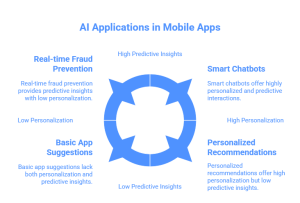
Looking for inspiration on scalable, multi-platform apps? See how past innovations thrived in our blog on COVID-era mobile app ideas.
Augmented and Virtual Reality
From commerce to medicine, AR and VR are creating new opportunities—from virtual try-on to immersive medical simulations. To deliver these experiences, a new architecture of the app is necessary that can provide high performance and low latency.
Internet of Things (IoT) Connectivity
Mobile applications are increasingly serving as command centers for IoT devices. A shipping company, for instance, may monitor shipments in real time via sensors connected to mobile applications. Facilitating this degree of connectivity requires scalable mobile applications with architectures optimized for real-time synchronization.
Conclusion
Mobile app architecture in 2025 is not just about design—it’s about creating solutions that are secure, flexible, and poised to grow with your business. By prioritizing custom app architecture 2025, IT leaders can make sure that their applications are prepared not only for today’s needs but for tomorrow’s breakthroughs.
We, at Techmango Technology Services, assist companies in developing and implementing contemporary app architecture that drives scalable mobile applications. If your aim is to maximize user experience, simplify operations, or future-proof your business for upcoming technologies such as AI and IoT, we are able to turn your idea into reality.
Ready to turn your architecture blueprint into a business-ready app? Explore our expert execution. & gain a competitive edge with reliable mobile app development services
A great breakdown of why mobile app architecture is the backbone of performance and scalability. Choosing the right structure not only ensures smooth functionality but also prepares the app for future growth. Solid insights for any business aiming to build high-quality, future-ready mobile applications!