



Enterprise web application development has become a foundational element of digital transformation. It enables organizations to strengthen customer engagement, improve operational efficiency, and unlock new growth opportunities. The global web development services market is projected to reach USD 80.6 billion by 2025 and exceed USD 125.4 billion by 2030, growing at a CAGR of 9.3% (Mordor Intelligence).
For business leaders, this growth highlights a clear reality: a well-designed enterprise web application is a strategic necessity for staying relevant and resilient.
Across Middle Eastern markets, particularly Saudi Arabia, demand for enterprise web applications continues to rise. Rapid digital adoption, national transformation programs, and a growing IT ecosystem are driving businesses to invest in scalable, intelligent web platforms that support growth as the digital landscape evolves.
As 2026 approaches, enterprise focus is shifting toward applications that deliver intuitive experiences, scale seamlessly, and adapt continuously—driven by advances in AI, cloud-native development, and immersive technologies.
Looking at how AI is transforming development across platforms? Don’t miss our blog on AI-Powered Innovation in Mobile App Development, which highlights the cutting-edge changes AI is driving in digital solutions.
Below are game-changing enterprise web application development trends shaping business success in 2026.
1. Human-Centered Experiences
Organizations are designing applications that prioritize usability, inclusivity, and adaptability. Human-centered design focuses on how people actually work, not how systems expect them to behave.
By embedding behavioral analytics and feedback loops, enterprise web applications evolve continuously—improving adoption, satisfaction, and productivity. For executives, this translates into better utilization of digital investments and stronger workforce efficiency.
2. Generative Design and AI-Augmented Creativity
AI-powered generative design is redefining how enterprise applications are created. Instead of static templates, teams define goals and constraints while AI produces optimized design variations.
This approach accelerates innovation, reduces design cycles, and allows applications to evolve alongside business needs—an essential capability for enterprises operating in fast-changing markets.
3. Serverless Architectures for Agility
Serverless computing continues to gain momentum in enterprise environments. By abstracting infrastructure management, organizations benefit from built-in scalability, resilience, and cost efficiency.
Developers focus on business logic rather than infrastructure, enabling faster releases and innovation. Serverless architectures also help enterprises balance growth ambitions with cost discipline—a critical requirement in 2026.
4. Single Page Applications (SPAs) to Drive Engagement
Single Page Applications deliver fast, responsive, and app-like experiences by eliminating full page reloads. Users experience seamless interactions, which directly impacts satisfaction and retention.
SPAs are especially valuable for:
- E-commerce platforms
- SaaS products
- Knowledge-intensive enterprise systems
In these environments, speed and responsiveness strongly influence engagement and adoption.
Enterprise applications often face similar issues as mobile platforms. Learn how to tackle development challenges effectively in our blog on Solving Significant Mobile App Development Challenges in 2024.
5. Voice Search and Conversational Interfaces
Voice and conversational interfaces have evolved into business-critical capabilities. Enterprise web applications now integrate voice search, chat interfaces, and conversational workflows to help users retrieve information, complete tasks, and access insights faster.
These interfaces enhance accessibility, reduce interaction friction, and allow organizations to engage users through more natural and intuitive experiences.
6. Immersive and Metaverse-Enabled Solutions
Immersive technologies such as AR, VR, and metaverse-enabled environments are expanding enterprise use cases. From virtual product demonstrations to collaborative digital workspaces, immersive web applications enable deeper engagement.
Leading enterprises are piloting 3D visualization, digital twins, and virtual collaboration platforms to deliver richer and more differentiated digital experiences.
7. Composable and Modular Architecture
Enterprises are increasingly adopting composable architectures, where applications are built using loosely coupled, reusable components.
This approach enables:
- Faster innovation without disrupting core systems
- Independent scaling of features
- Easier integration with new technologies
Composable systems give enterprises flexibility and long-term sustainability—key advantages in dynamic markets.
8. AI-Driven Personalization at Scale
Personalization has moved beyond static rules. In 2026, enterprise web applications leverage AI to adapt content, workflows, and interfaces in real time.
AI-driven personalization improves:
- User relevance and engagement
- Conversion and task completion rates
- Satisfaction across diverse user roles
For enterprises, this means web platforms that feel tailored rather than generic.
9. Zero-Trust Security and Privacy-by-Design
With rising cyber risks and stricter regulations, security is embedded directly into application architecture.
Zero-trust models assume no implicit trust and continuously validate access. Privacy-by-design ensures data protection is built into workflows rather than added later. These practices strengthen enterprise trust, compliance readiness, and risk management.
10. Data-Connected Enterprise Platforms
Modern enterprise web applications act as intelligence layers, not isolated systems. They connect seamlessly with analytics platforms, operational dashboards, and AI models to support real-time decision-making.
This integration allows leaders to move from reactive reporting to proactive insights—turning web platforms into strategic command centers.
Why Enterprises Seek Professional Web App Development Partners
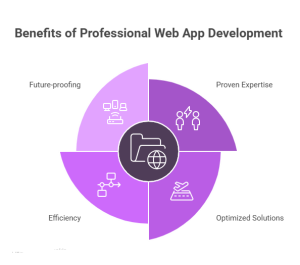
Adopting these trends requires more than technology—it requires disciplined execution. Enterprises work with professional web app development partners to ensure:
- Proven Expertise – Teams with deep industry and architectural experience
- Optimized Solutions – Platforms aligned with business goals and brand identity
- Efficiency – Faster time-to-market with controlled costs
- Future-readiness – Smooth adoption of new technologies without disruption
A strong partner ensures innovation translates into measurable business outcomes.
Final Thoughts
Enterprise web applications have transitioned from being just operational tools to becoming live catalysts of growth. Firms that place high importance on human-centered design, cloud-native agility, AI intelligence, and immersive experiences will have a big advantage over the ones that keep sticking to the traditional ways.
Winning in 2026 will rely on having a clear intention, clarity, and proper execution—not merely on following the trends.
Techmango is committed to creating future-ready enterprise web solutions that enable organizations to easily adapt, compete, and therefore scale with confidence. Techmango’s offshore development, consulting, or end-to-end delivery all come with the marriage of execution discipline and innovation.
The future of enterprise web applications is being made at the present time. What lies ahead is not the question but rather how ready you are to dominate it.