



Are you using data or just storing it?
This is the real question most executives are starting to ask themselves.
Organizations generate more data every quarter than they produced in an entire decade. Yet, almost every leader we speak with admits the same thing:
“We know the data exists—we just can’t use it consistently.”
Access isn’t the challenge anymore. Applied value is.
Why data engineering has become a strategic capability
Modern business runs on real-time intelligence—not monthly reports.
That puts pressure on:
- Data quality
- Architectural maturity
- Reliable pipelines
- Scalable storage
- Cloud infrastructure
Without engineering, analytics becomes guesswork.
And no enterprise has room for guesswork anymore.
What modern data engineering actually means in 2026
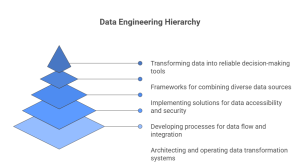
Data engineering has expanded far beyond ETL.
Today it includes:
- Cloud-native pipelines
- Lakehouse platforms
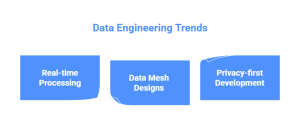
- Real-time streaming
- Data observability
- Governance & lineage
- Secure processing
- AI-ready architecture
It’s foundational work—not just operational work.
Why analytics and dashboards are not enough
Dashboards answer questions.
Data engineering ensures those answers are right.
If your inputs are inconsistent, outdated, or siloed—dataset visualization only displays a better looking problem.
A modern data stack only creates value if the engineering underneath can support it.
Key areas where enterprises struggle with data today
Across industries, we see the same recurring pain points:
- Legacy database dependency
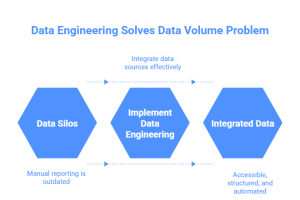
- Fragmented sources
- Manual reporting
- Duplicated records
- Slow integration
- Inconsistent definitions
- Limited real-time capability
- Lack of data ownership
These aren’t analytics problems—they’re engineering problems.
How modern data engineering connects directly to business results
Data engineering improves measurable enterprise outcomes:
Operational efficiency
Less rework, faster reporting
Decision accuracy
High-quality data in executive dashboards
Scalability
Handle new products, markets, and workloads
Compliance readiness
High-trust and auditable architecture
Foundation for AI initiatives
AI fails without engineered data
Every transformation strategy depends on engineered infrastructure.
Use cases gaining traction in 2026
We’re seeing high growth in data-driven areas such as:
- Real-time decision systems
- Customer 360 analytics
- IoT data consolidation
- Predictive maintenance
- Multi-cloud analytics
- AI/ML data readiness
The common denominator?
Strong engineering behind the scenes.
What reliable data engineering services look like
Enterprises should expect:
- Scalable cloud platforms
- Automated pipelines
- Data quality enforcement
- Streaming capability
- Unified architecture
- Security built-in
- Modern governance
This is about building a future-proof data foundation, not just a technology project.
How to choose a partner that protects long-term value
When selecting a data engineering partner, consider:
- Technical depth
- Architecture capability
- Cloud expertise
- Industry knowledge
- Documentation standards
- Governance maturity
- Measurable delivery history
Tools and dashboards don’t determine value. Architecture does.
Why Techmango
Techmango delivers modern, engineering-first solutions across:
- Cloud data platforms
- ETL/ELT modernization
- Real-time pipelines
- Lakehouse solutions
- Observability
- Governance
- Integration at scale
We engineer usable, trustworthy, and AI-ready data foundations—designed specifically to support enterprise growth.
Our focus is simple:
Make data reliable. Keep it usable. And prepare you for what comes next.