



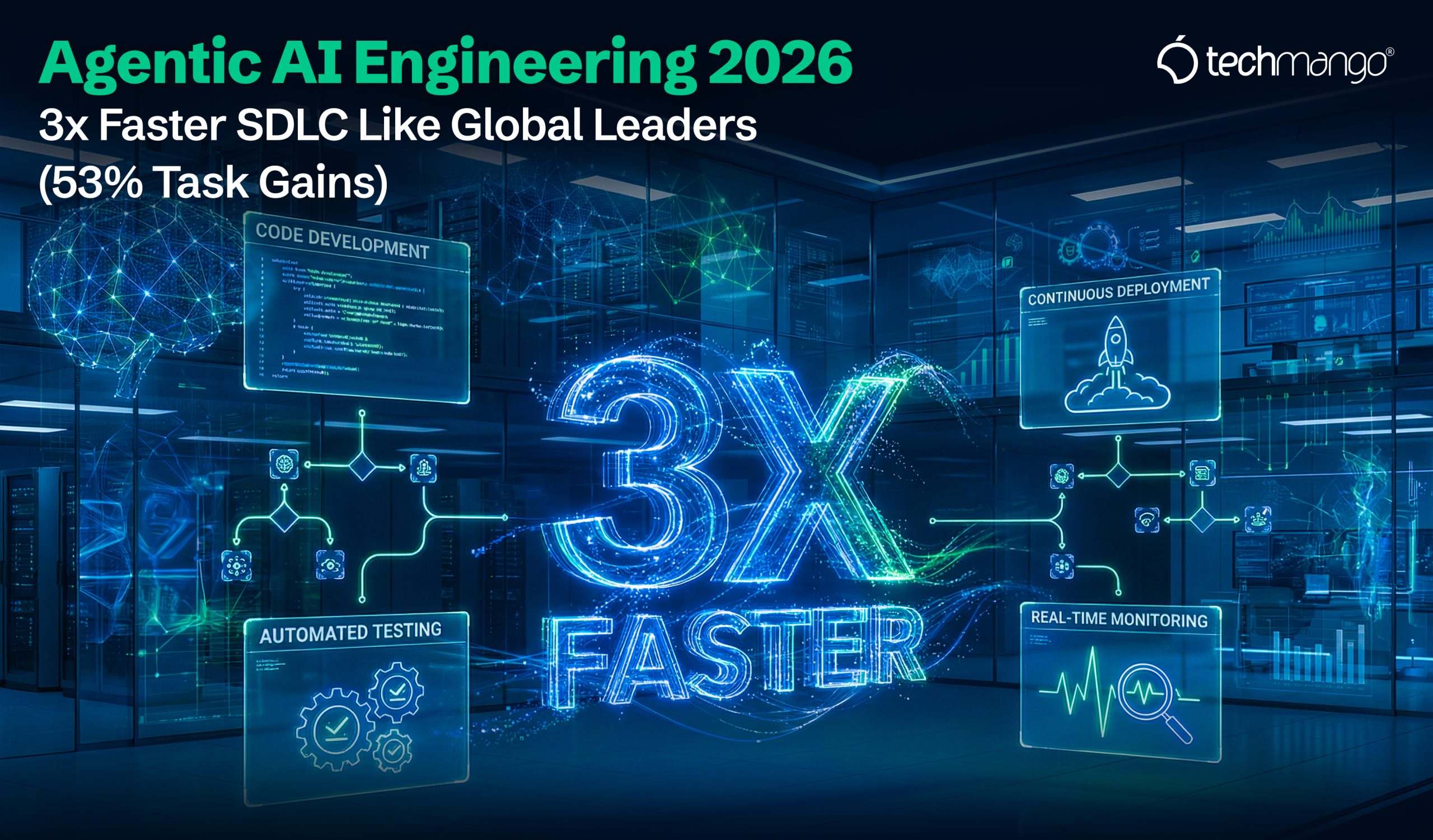
The Agentic AI Revolution Reshaping Engineering
By 2026, software engineering inside large enterprises has reached an inflection point. Delivery expectations have accelerated, while traditional SDLC models continue to struggle with execution drag. Cloud adoption, DevOps pipelines, and AI-assisted coding tools improved productivity incrementally, but they have not removed the fundamental dependency on human-driven workflows.
Across US enterprises, engineering leaders report recurring bottlenecks:
- Manual planning cycles delay execution
- Coding velocity constrained by review backlogs
- Testing remains sequential and time intensive
- Operations teams operate in silos
- Release cycles expand while costs rise
This gap between business demand and engineering capacity is now structural.
Agentic Artificial Intelligence introduces a different operating model.
Agentic AI replaces task-by-task assistance with autonomous execution. Instead of helping engineers write code faster, AI agents take ownership of engineering outcomes. They plan, execute, validate, and adapt continuously.
Global leaders such as Microsoft, Google, and frontier AI-native organizations have already operationalized this model. Reported outcomes include:
- 53 percent task automation across SDLC activities
- 3x acceleration in release velocity
- Reduced rework and operational friction
- Higher engineering predictability
Techmango applies these same principles to enterprise delivery. Through offshore agentic AI engineering teams, Techmango enables US organizations to deploy autonomous AI systems with enterprise-grade governance, HIPAA and BFSI compliance, and measurable SDLC acceleration.
What is Agentic AI Engineering?
Agentic AI Engineering represents the evolution from generative AI tools to autonomous engineering systems.
Generative AI produces outputs when prompted. Agentic AI executes objectives.
An agentic system is composed of intelligent agents that:
- Understand high-level goals
- Break goals into executable tasks
- Select tools and workflows
- Maintain memory across execution cycles
- Coordinate with other agents
- Escalate decisions when required
In software engineering, this means AI agents operating across the full SDLC rather than supporting isolated steps.
Agentic AI Engineering transforms development from a linear process into a coordinated multi-agent system.
Core Components
LLM Backbone
Advanced large language models provide reasoning, code synthesis, and decision logic. Techmango deploys enterprise-ready LLM stacks including GPT-class and Claude-class models, configured for data security and compliance.
Agent Frameworks
Frameworks such as LangChain, CrewAI, LangGraph, and AutoGen enable agents to reason, use tools, and collaborate across tasks.
Multi-Agent Orchestration
Agents function as teams with defined roles. Planning agents, coding agents, review agents, QA agents, and deployment agents work together under controlled orchestration.
This orchestration layer is where Techmango differentiates, ensuring reliability, traceability, and production readiness.
How Agentic AI Delivers 3x Faster SDLC
Agentic AI accelerates delivery by redesigning each SDLC phase.
Planning
Planning agents ingest product requirements, stakeholder documents, backlog items, and historical delivery data. They automatically generate epics, user stories, acceptance criteria, and effort estimates.
Dependencies and risks are surfaced early.
Outcome:
- Planning cycles reduced from weeks to hours
- Product leaders focus on prioritization instead of documentation
- Engineering teams receive execution-ready backlogs
Coding
Techmango deploys dual-agent coding patterns:
- A primary coding agent implements features
- A secondary review agent validates logic, performance, security, and standards
This continuous peer-review model reduces rework significantly.
Outcome:
- Pull request cycles reduced by up to 70 percent
- Consistent coding standards enforced automatically
- Higher throughput with lower defect density
Testing
Autonomous QA agents generate, execute, and maintain test suites. These agents run continuously against evolving codebases and detect regressions early.
Outcome:
- Up to 95 percent automated test coverage
- QA cycles compressed dramatically
- Release confidence improves without slowing velocity
Deployment
Deployment agents manage CI/CD pipelines, infrastructure changes, canary releases, and rollback strategies. These agents operate under policy controls and observability frameworks.
Outcome:
- Deployment frequency increases without risk
- Mean time to recovery decreases
- Sprint cycles shrink from two weeks to approximately five days
This is how enterprises achieve 3x SDLC velocity without increasing headcount.
Real-World Gains: 53% Task Automation Like Global Leaders
Agentic AI adoption is no longer theoretical.
Global Benchmarks
- OpenAI engineering teams use agent swarms to accelerate API development and internal tooling, achieving approximately 40 percent faster delivery.
- US fintech organizations deploy fraud detection and model lifecycle agents, reducing model training and iteration time by nearly 60 percent.
Techmango Client Results
A UAE-based BFSI enterprise with US regulatory exposure partnered with Techmango to deploy agentic AI across its application lifecycle.
Results achieved:
- 3x faster application rollout
- 45 percent reduction in total cost of ownership
- Improved audit traceability and compliance readiness
- Reduced dependency on manual engineering interventions
This demonstrates agentic AI operating at enterprise scale under regulatory constraints.
Agentic AI Frameworks & Tools for 2026
Tier-1 Enterprise Stack
Frameworks
- CrewAI for role-based agent collaboration
- LangChain for tool-aware reasoning
- AutoGen and LangGraph for stateful workflows
Infrastructure
- Kubernetes for orchestration
- Ray for distributed agent execution
Observability
- LangSmith for agent tracing
- AgentOps for performance monitoring
Governance
- Role-based agent permissions
- Execution policies
- Audit logs and lineage tracking
Techmango Recommendation
Pure automation without governance introduces risk. Techmango implements hybrid agentic delivery models combining autonomous agents with human oversight.
This model provides:
- 3x delivery speed
- Approximately 50 percent cost advantage compared to onshore-only teams
- Enterprise-grade control and compliance
US Enterprise Roadmap: Implement Agentic AI in 90 Days
Phase 1: Pilot (Weeks 1 to 4)
The pilot phase establishes technical credibility, operational feasibility, and business confidence. This phase is not about experimentation. It is about proving that agentic AI can deliver measurable SDLC acceleration inside a controlled enterprise environment.
During this phase, Techmango deploys single-agent systems focused on one high-impact function such as code generation, unit testing, or backlog refinement. The objective is to isolate value, minimize risk, and establish governance patterns early.
Key activities
- Identify one engineering bottleneck with measurable impact
Examples include repetitive feature coding, regression test creation, or API documentation - Select a bounded codebase or service
Ensures controlled blast radius and clean ROI attribution - Configure enterprise LLM access
Includes security, data isolation, prompt governance, and usage monitoring - Deploy a single autonomous agent
Agent executes tasks independently within defined guardrails - Integrate with existing tools
IDEs, Git repositories, CI systems, and ticketing platforms
Governance and controls
- Human approval checkpoints for all agent outputs
- Prompt and output logging for auditability
- Role-based execution permissions
Outcomes delivered
- 20 to 30 percent reduction in task execution time
- Baseline metrics for velocity, quality, and cost
- Clear validation of agent behavior in enterprise context
By the end of Phase 1, leadership has proof of value, not prototypes. Engineering teams gain confidence, and governance stakeholders gain visibility.
Phase 2: Scale (Month 2)
Phase 2 expands agentic AI from isolated tasks into multi-agent SDLC workflows. This is where true acceleration begins.
Techmango introduces collaborative agents that work together across planning, coding, testing, and deployment. Each agent has a defined role and communicates with others through controlled orchestration.
Key activities
- Introduce role-based agents
Planning agent, coding agent, review agent, QA agent, and DevOps agent - Establish agent collaboration logic
Task handoffs, dependency resolution, and conflict handling - Integrate deeply with enterprise toolchains
Git, Jira, Jenkins, GitHub Actions, cloud platforms, and monitoring tools - Enable continuous execution
Agents operate across sprints rather than per request - Introduce feedback loops
Agents learn from review comments, test failures, and deployment outcomes
Quality and risk management
- Automated policy enforcement on code quality and security
- Review agents validate outputs before promotion
- QA agents run continuously to detect regressions early
Outcomes delivered
- 2 to 3x increase in SDLC throughput
- 60 to 70 percent reduction in rework and PR churn
- Release cycles compressed from weeks to days
- Engineering teams shift from execution to oversight
By the end of Phase 2, agentic AI becomes part of the delivery engine, not an add-on.
Phase 3: Enterprise Rollout (Month 3)
Phase 3 transforms agentic AI into a core enterprise capability. This phase focuses on scale, governance, and sustainability.
Techmango deploys governance agents that oversee execution, compliance, and performance across teams and portfolios. Agentic systems are now aligned with enterprise policies, regulatory requirements, and strategic objectives.
Key activities
- Deploy governance and compliance agents
Enforce security standards, coding policies, and regulatory controls - Enable organization-wide adoption
Roll out agentic workflows across multiple teams and products - Integrate compliance automation
Audit logs, traceability, and policy reporting built into execution - Establish operational ownership
Clear accountability models for agent behavior and outcomes - Define continuous optimization strategy
Performance tuning, cost controls, and agent evolution roadmap
Enterprise benefits
- Predictable and repeatable delivery velocity
- Consistent quality across teams and geographies
- Built-in audit readiness for regulated industries
- Sustainable cost optimization without delivery risk
By the end of Phase 3, agentic AI is no longer a transformation initiative.
It becomes the default operating model for engineering.
Executive takeaway
This phased approach ensures:
- Fast value realization
- Controlled risk exposure
- Enterprise-grade governance
- Long-term scalability
Techmango enables organizations to move from pilot to production to platform in just 90 days, delivering agentic AI engineering that is fast, compliant, and built for scale.
Why UAE and US Firms Choose Techmango for Agentic AI
Techmango delivers execution maturity, not experimentation.
Key differentiators:
- 50+ enterprise AI programs delivered
- Proven BFSI, healthcare, and fintech expertise
- HIPAA, SOC2, FHIR-aligned engineering practices
- Offshore excellence combined with enterprise governance
- Outcome-driven delivery aligned to business KPIs
Techmango builds AI-powered engineering systems, not isolated tools.
Conclusion: Lead with Agentic AI in 2026
Agentic AI Engineering defines the next era of software delivery.
With 53 percent task automation, 3x SDLC acceleration, and lower operational costs, enterprises that adopt agentic systems gain a durable competitive advantage.
The choice for 2026 leaders is execution, not experimentation.
Techmango enables organizations to operationalize agentic AI safely, scalably, and profitably.