




Introduction
Mobile apps are no longer side initiatives—they’re frequently the primary means by which consumers engage with a brand and the foundation of internal productivity. Given that global app revenue will hit $765 billion by 2025 (Statista), how you develop and sustain apps has a direct influence on how competitive you remain.
The selection of development methodology is not only a technical aspect. It affects the pace at which you deliver, how scalable your product is, and the ROI you achieve in the long run. At Techmango Technology Services, we have repeatedly observed that when companies select the best approach initially, they avoid spending large amounts of money on rework and create more effective user experiences.
Want to know what’s trending in mobile development? Explore modern mobile app practices shaping the future of development.
What Are the Most Effective Mobile App Development Methodologies?
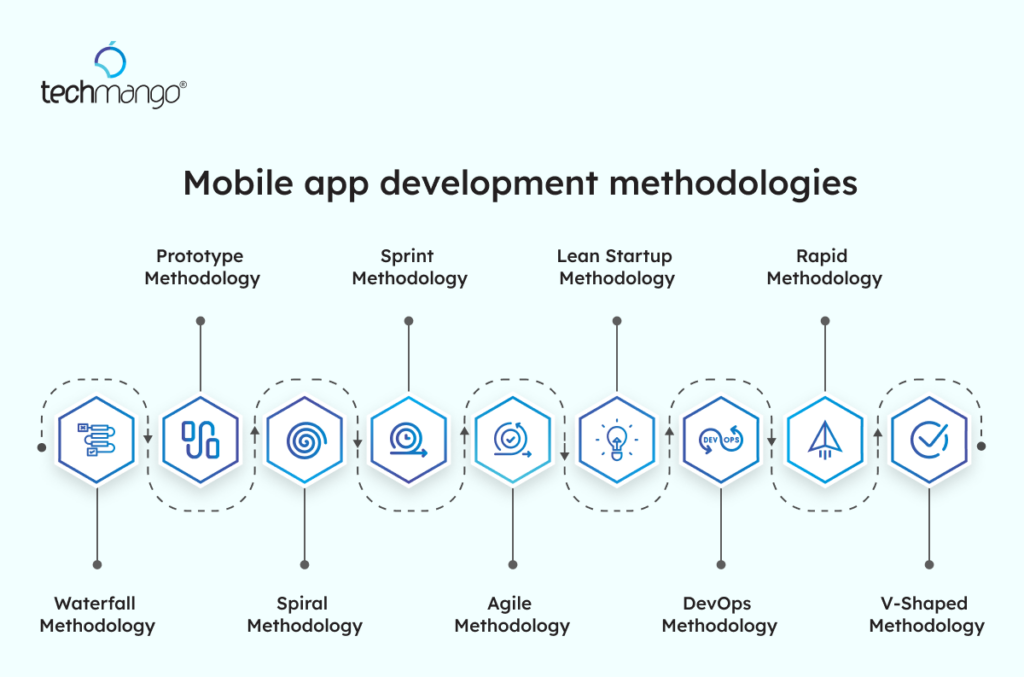
Agile Methodology: How Does It Accelerate App Delivery?
Agile is still the favorite when there’s a need for flexibility. Teams deploy in short spurts, iterate as they move along, and ship features in regular intervals rather than holding out for months for a massive launch. For rapidly evolving sectors such as e-commerce or fintech, Agile makes it easier to keep apps aligned with user needs.
Why it works in 2025: customer needs change quickly, and Agile makes sure your app keeps pace.
Waterfall Methodology: Is It Still Relevant in 2025?
Waterfall often gets dismissed as old-fashioned, but let’s be fair—it still has value. If you’re working in sectors like healthcare, government, or construction where documentation and compliance are non-negotiable, a linear step-by-step approach makes sense.
Best fit: projects with fixed requirements and little chance of scope creep.
DevOps Integration: Why Is It Critical for Continuous Delivery?
DevOps isn’t an obsession with tools—it’s a matter of culture. It closes the gap between dev and ops so companies avoid getting trapped in silos. With DevOps, you have:
- Automated CI/CD pipelines for faster rollouts
- Continuous monitoring that minimizes risk
- Updates that occur seamlessly with less downtime
For companies developing cloud-native or large-scale applications, DevOps has become “essential” rather than “nice-to-have.”
Lean Development: How Can Businesses Reduce Waste & Boost Efficiency?
Lean is simple and it’s targeted. No extra features, no wasted effort—just what really creates business value. Startups particularly adore Lean because it means they can experiment, remain lean on expenses, and scale only the winners.
How Low-Code & No-Code Platforms Are Changing the Game
What Are the Advantages of Low-Code Development?
Low-code tools accelerate the delivery by allowing developers to work with pre-built elements rather than beginning from the ground up. Gartner estimates that nearly 70% of new applications in 2025 will include low-code technologies.
Why it’s valuable to companies like yours:
- Development cycles become much shorter
- Enterprise integration is smoother
- Reusable modules keep costs under control
How Do No-Code Tools Benefit Non-Technical Teams?
No-code technology empowers business teams to build apps without relying on IT for all of it. Marketing could fire up a campaign app, HR would develop onboarding tools, or operations would create workflow automations.
But here’s the thing: when you do need scale, performance, or customization, no-code alone can no longer keep up. That’s when having a partner like Techmango ensures what you build today can grow with you tomorrow.
Which Frameworks Support Modern Development Practices?
Flutter, React Native & Kotlin Multiplatform: Which Should You Choose?
In 2025, cross-platform frameworks rule the roost:
- Flutter → Ideal for apps having rich, consistent visual UI.
- React Native → Friendly with teams that deliver regular updates.
- Kotlin Multiplatform → Excellent option for complex apps that require native-level performance.
Facing technical hurdles or complexity? Learn how to overcome the biggest mobile app development challenges in 2024.
The best choice is your app’s objectives, budget, and how future-proof you want it to be.
Progressive Web Apps (PWAs): Are They a Viable Alternative?
PWAs smooth over the line between apps and websites. They provide an app-like experience via the browser and eliminate the risk of app store approvals. For organizations aiming to maximize reach without incurring prohibitive costs, PWAs are certainly an option to be weighed.
Why Continuous Testing & QA is Vital
How Do Automated Testing Tools Improve Quality & Speed?
Automated testing is similar to having a safety net for every launch. It finds bugs early, verifies performance, and speeds up go-to-market.
Why Manual Testing Is Still Important
But let’s be realistic—automation has its limits. User experience, accessibility, and edge cases still require a human touch. The best QA strategy is a balanced blend of both.
Best Practices for Selecting the Right Methodology
How to Match Methodology to Project Type
- Agile → Ideal for changing projects with ongoing iterations
- Waterfall → Best when compliance or documentation is the day
- DevOps + Agile → A great combination for cloud-native business apps
- Lean → Great for startups experimenting with MVPs and going fast
Cost, Timeline & Resource Considerations
- Agile and DevOps do seem like a higher initial investment, but they tend to pay dividends with faster ROI.
- Waterfall can look less expensive at first but expensive if things change halfway through.
- Low-code/no-code saves on development expenses but typically requires professional guidance in order to scale adequately.
Conclusion
Choosing the right custom app development process isn’t about following fashions—it’s ensuring your app has the ability to grow alongside your business and provide tangible results.
Techmango Technology Services assists businesses in aligning the correct methodology with the correct tools so that not only do they create apps, but create apps that are here to stay. If it’s modernizing a legacy application or designing something entirely new, our goal is to ensure the strategy returns measurable ROI.
Interested in knowing what methodology best suits your next project? Let’s discuss your app objectives and discover the optimal route ahead.
Want expert guidance in applying the right methodology to your mobile app? Discover our mobile app development services built to help you succeed.