




Here’s a question many technology leaders are quietly asking:
Why are we still building and maintaining two separate mobile apps when our business roadmap keeps getting tighter?
For years, custom mobile app development was the default answer. Separate Android and iOS teams. Separate codebases. Separate timelines. That model worked—until speed, cost control, and scalability became board-level concerns.
Today, React Native has moved well beyond “cross-platform convenience.” In 2026, it’s a serious enterprise option for organizations that want to move faster without cutting corners.
Techmango works with CTOs and product leaders who aren’t chasing trends – they’re making architecture decisions that need to hold up for years. This article explains why React Native continues to earn its place in modern mobile strategies, and when it truly makes sense.
Want to explore what’s new in React Native? Check out our guide on the latest React Native trends to unlock its full potential.
Why the Conversation Around React Native Has Changed ?
React Native isn’t new but how it’s used has evolved.
Early adoption focused on saving time. Now, enterprises care about:
- Faster release cycles
- Consistent user experience across platforms
- Easier long-term maintenance
- Better alignment between product and engineering teams
React Native answers these needs because it allows teams to share a large portion of code while still delivering near-native performance. More importantly, it fits well into modern, API-driven and cloud-native architectures.
What React Native Solves for Enterprise Teams
One Codebase, Fewer Trade-Offs
Maintaining separate Android and iOS apps doubles more than just development effort. It increases testing time, slows feature parity, and complicates upgrades.
React Native reduces this friction by allowing:
- Shared business logic across platforms
- Faster rollout of new features
- More predictable release planning
For leadership teams, this often means shorter time-to-market and tighter cost control without sacrificing quality.
Performance That Meets Real-World Expectations
A common concern is performance. The reality in 2026 is that React Native apps power products used by millions every day.
With improvements like the new architecture, Fabric renderer, and TurboModules, React Native handles:
- Complex user flows
- Animations and gestures
- High-frequency data updates
For most enterprise use cases – marketplaces, dashboards, logistics apps, B2B platforms – React Native delivers performance users expect.
Faster Development Without Cutting Quality
Speed matters, but only when it doesn’t create rework later.
React Native accelerates development through:
- Hot reloading for faster iteration
- A mature ecosystem of libraries
- Strong TypeScript support for safer code
This allows teams to focus on solving business problems instead of rebuilding the same functionality twice.
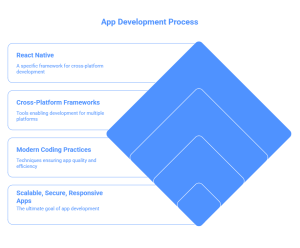
Why React Native Fits Modern Enterprise Architecture
API-First and Backend-Friendly
Most enterprise systems today rely on APIs, microservices, and cloud platforms. React Native fits naturally into this setup.
It works well with:
- REST and GraphQL APIs
- Cloud-native backends
- Headless CMS and commerce platforms
This alignment makes React Native a strong choice when mobile apps are part of a broader digital ecosystem not standalone products.
Easier Long-Term Maintenance
One of the biggest hidden costs in mobile development is upkeep.
React Native simplifies maintenance by:
- Reducing duplicate fixes across platforms
- Allowing shared upgrades and refactoring
- Making onboarding easier for new developers
For CTOs managing large teams or multiple apps, this translates to lower operational overhead over time.
When React Native Makes the Most Sense
React Native is especially effective for:
- Enterprise internal apps
- Customer-facing platforms with frequent updates
- MVPs that need to scale quickly
- B2B and SaaS products
- Retail, logistics, fintech, and healthcare solutions
It may not be the right fit for apps requiring heavy 3D graphics or extremely device-specific hardware control but those cases are the exception, not the norm.
Already working with React Native? Learn how to boost your app’s efficiency with React performance optimization techniques.
Common Misconceptions Leaders Still Have
“React Native is only for startups.”
Not true. Many enterprise-grade products rely on it today.
“It limits future scalability.”
Poor architecture limits scalability—not the framework.
“Native apps are always better.”
Native is sometimes better. Often, React Native is smarter.
The real decision isn’t React Native vs native.
It’s business velocity vs engineering drag.
How Techmango Builds React Native Apps That Scale
At Techmango, we don’t treat React Native as a shortcut. We treat it as a strategic choice.
Our approach focuses on:
- Architecture-first design
- Clean separation of concerns
- Secure, scalable backend integration
- Performance optimization from day one
- Long-term maintainability, not quick wins
We help enterprises decide when React Native is the right choice and when it isn’t. That clarity saves time, money, and rework later.
Questions CTOs Should Ask Before Choosing React Native
Before committing, it’s worth answering:
- How complex are our workflows and integrations?
- Will this app evolve significantly over time?
- Do we need fast feature parity across platforms?
- How important is maintenance efficiency?
- Is our backend designed to support scale?
Clear answers here usually make the decision obvious.
Final Take: React Native as a Strategic Advantage
In 2026, React Native isn’t about doing more with less, it’s about doing the right things faster.
For organizations that value speed, consistency, and long-term efficiency, React Native remains one of the most practical choices in mobile app development.
At Techmango, we help enterprises turn that choice into a durable, scalable product—built to support growth, not slow it down.
If you’re evaluating your next mobile app or planning a modernization, it’s worth having a serious conversation about React Native.
Let’s build mobile solutions that move at the speed of your business.
Ready to build a powerful app with React Native? Explore our React Native development to get started.