



By 2025, American companies will spend more than $135 billion to develop mobile apps, and cross-platform solutions will remain the dominant methodology. Companies are being pushed more and more to reach the market sooner, reduce costs, and deliver seamless experiences across devices. But developing two independent native apps for Android and iOS generally means twice the engineering expense, a longer time-to-market, and more maintenance effort.
This is how Flutter app development USA can prove to be a game-changer for app development. The developers are able to achieve the same native-like performance using one codebase, quick iteration, and create cost-effective, scalable, and future-proof platform-independent mobile apps USA with high-quality UX on devices.
How Flutter Addresses challenges with Mobile App Development
Traditional mobile app development requires separate codebases for iOS and Android, leading to increased development costs, extended release cycles, and complicated maintenance. Flutter solves these problems with:
- Single codebase: reduces duplicate work and ongoing maintenance.
- Hot reload: accelerates UI iterations, enabling rapid testing and validation.
- Rich widget library: provides visually appealing, consistent designs.
The result is faster time-to-market, lower operational risk, and predictable cost — key considerations for U.S. executives and CFOs.
What is Flutter & Why It’s Gaining Traction in the USA
Flutter is Google’s open-source UI toolkit that uses Dart and compiles directly to native machine code. Its adoption in the U.S. is growing because it:
- Cuts development timelines and costs by up to 40% compared to separate native apps.
- Delivers native-like performance on both Android and iOS.
Supports integrations with APIs, cloud services, and AI/ML models.
Related Blogs
What are the Benefits of Cross-platform Application Development?
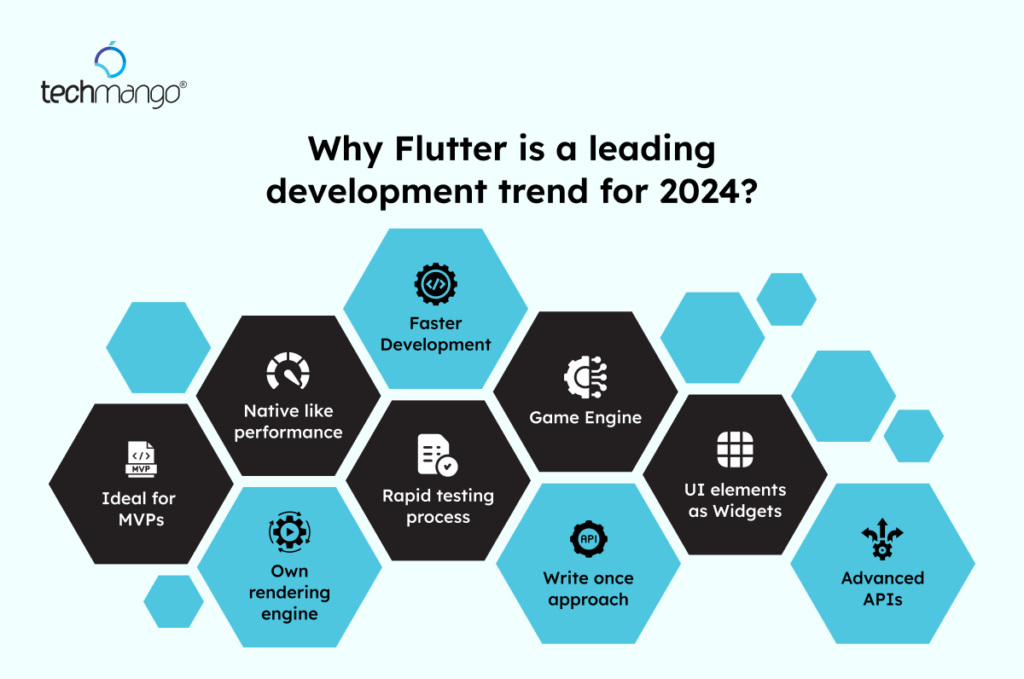
What Makes Flutter a Leading Trend for Cross-Platform App Development?
- Single codebase for iOS, Android, web, and desktop
- Hot reload for rapid prototyping and faster iteration
- Rich widget library for responsive, engaging UI
- Strong community and enterprise adoption ensures long-term support
How Does Flutter Provide a Unified Digital Experience?
Flutter ensures consistent behavior across devices, helping businesses maintain brand integrity and seamless user experiences. Shared business logic, unified UI components, and GPU-accelerated rendering deliver a cohesive digital presence across mobile, web, and desktop.
How Does Flutter Deliver Native-Like Performance Across Platforms?
- Ahead-of-time compilation reduces startup time
- Skia graphics engine enables smooth animations and transitions
- Optimized rendering pipelines ensure 60–120 FPS for responsive UI
What Key Benefits Does Flutter Offer to U.S. Businesses?
Benefits of Using Flutter for App Development in the USA
- Cost savings: A single codebase minimizes engineering and QA costs.
- Rapid delivery: Rapid prototyping and hot reload enable shorter release cycles.
- Consistent user experience: A consistent experience across devices.
- Scalable architecture: Scalable for cloud, AI/ML, and enterprise integrations.
- Future-ready applications: Extendable to the web and desktop without complete redevelopment
What Challenges Should U.S. Companies Know Before Using Flutter?
Common Drawbacks or Risks
- Larger app size compared to native apps
- Some native APIs may require custom plugins
- Certain enterprise-grade SDKs may need additional development
- Teams unfamiliar with Dart need training (2–4 weeks ramp)
How Much Does Flutter App Development Cost in the USA?
Typical Cost of Building a Flutter App
- Simple apps (MVP): $30k–$60k | 8–12 weeks
- Mid-range apps: $60k–$150k | 3–5 months
- Complex/Enterprise apps: $150k–$400k+ | 5–10 months
Team model: PM, Senior Flutter Engineer, Backend Engineer, UI/UX Designer, QA Specialist | blended vendor rates $50–110/hr.
In What Industries Is Flutter Particularly Useful in the U.S.?
- Retail & E-Commerce: Consistent cross-platform shopping experiences
- Consumer Services & Marketplaces: Fast MVP testing
- Enterprise Apps: Single app for employees across devices
- Startups & SMBs: Cost-effective MVPs for validation
- EdTech & SaaS: Reusable UI across mobile and web
Which U.S. Industries Benefit Most?
Retail, FinTech, Logistics, EdTech, and internal enterprise tools show the best cost-to-benefit ratio for Flutter.
How to Get Started with Flutter for Your Business
- Define MVP/core user journeys
- Select KPIs: MAU, retention, conversion
- Choose target platforms: mobile, web, desktop
- Adopt a delivery model: onshore architect + offshore execution
- Prototype with Figma/XD to validate flows
- Launch MVP in 8–12 weeks, then iterate based on metrics
Future Trends for Flutter & Cross-Platform Development
- AI/ML on-device for personalization
- Web & desktop convergence with a single codebase
- IoT & AR/VR support for immersive experiences
- Expanded enterprise plugin ecosystem
Recap: Why Flutter is Increasingly Compelling for U.S. Businesses
Flutter delivers cost-effective, high-performance solutions for U.S. companies seeking platform-independent mobile apps USA. Using cross-platform app development Flutter USA, businesses can accelerate time-to-market, reduce maintenance costs, and ensure consistent, scalable digital experiences.
For U.S. companies focused on ROI, efficiency, and long-term scalability, Flutter is not just a framework — it’s a strategic business tool.