




What if Generative AI isn’t failing your business—but your organization isn’t ready to use it the right way?
That’s a question many CEOs and CTOs are quietly asking in 2025.
Most enterprises have already experimented with Generative AI. Some built internal copilots. Others tested content automation, customer support bots, or code generation tools. Yet very few have scaled GenAI into something dependable, secure, and measurable.
The reason is simple: Generative AI delivers value only when strategy, data, governance, and execution move together.
This guide breaks down:
- Where Generative AI actually creates business value
- The most common challenges enterprises face
- Practical, proven ways to overcome them
- How organizations can move from experimentation to impact
Why Generative AI Has Become a Board-Level Topic
Generative AI is no longer just a technology conversation. It’s a leadership one.
Enterprises are paying attention because GenAI directly affects:
- Productivity across engineering, operations, and support
- Speed of decision-making
- Customer experience and personalization
- Cost structures and workforce efficiency
But there’s a gap between potential and real-world results.
Many leaders see early promise, followed by stalled pilots and rising concerns around security, accuracy, and governance.
That’s where most businesses get stuck.
Where Generative AI Actually Creates Business Value
Before addressing challenges, it’s important to be clear about where GenAI works best.
In enterprise environments, Generative AI delivers the most value when applied to:
- Knowledge-intensive workflows
Summarizing documents, extracting insights, generating reports, and supporting decision-making. - Engineering and IT operations
Code assistance, test generation, incident analysis, and internal documentation. - Customer engagement
AI-assisted support, personalized responses, and conversational interfaces—when grounded in trusted data. - Process automation
Reducing manual effort in back-office operations like finance, HR, and compliance.
The common thread?
GenAI works best when paired with strong data engineering and clear guardrails.
Prime Challenges Businesses Face with Generative AI
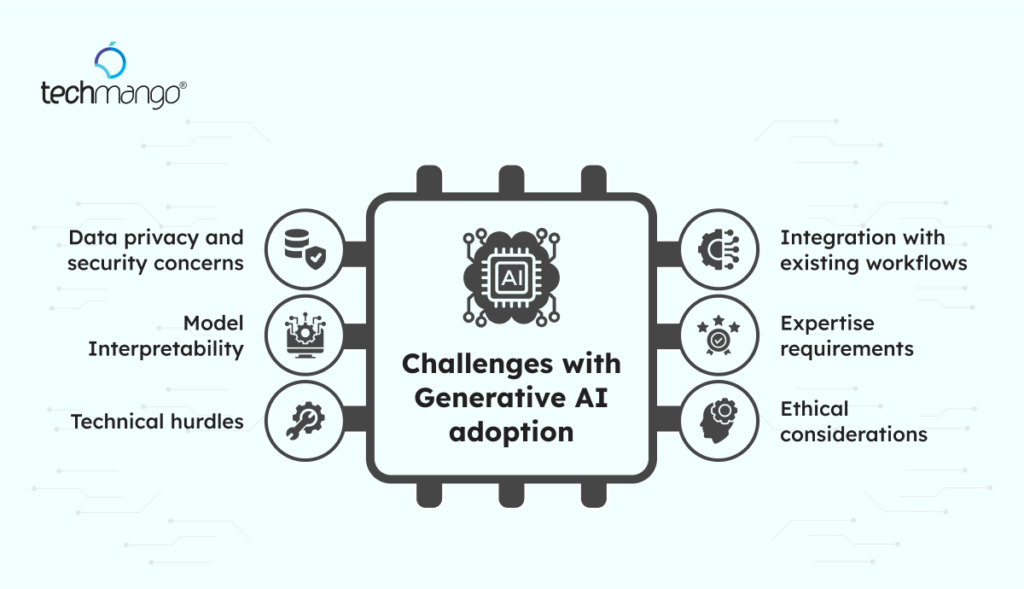
Despite the excitement, enterprises face very real obstacles when deploying Generative AI at scale.
1. Data Quality and Context Gaps
Generative AI is only as good as the data it learns from and retrieves. Poorly structured, outdated, or siloed data leads to unreliable outputs.
2. Security and Compliance Concerns
Leaders worry about:
- Data leakage
- Model exposure
- Regulatory compliance (HIPAA, SOC 2, GDPR, etc.)
These concerns are valid—and often underestimated early on.
3. Lack of Clear Use-Case Ownership
Many GenAI initiatives fail because no one owns outcomes. Experiments run, demos succeed, but business impact remains unclear.
4. Over-Reliance on Generic Models
Off-the-shelf models are powerful, but without customization, they often lack enterprise-specific understanding.
5. Integration Complexity
GenAI cannot live in isolation. It must integrate with existing systems, workflows, and data platforms.
These are not technical issues alone. They are organizational challenges.
Recent Blogs
How does GenAI transform global enterprise standards?
Recent Blogs
What are Techmango’s Gen AI strategies and best practices followed for businesses?
Your explanation is clear and I trust that other readers will share the same sentiment upon perusing your article. Appreciate you sharing this valuable insight. Additionally, I can also refer you to one of the Best Data science and AI consulting Services.
Data science and AI consulting Services
Your explanation is clear and I trust that other readers will share the same sentiment upon perusing your article. Appreciate you sharing this valuable insight. Additionally, I can also refer you to one of the Best Data science and AI consulting Services.
Data science and AI consulting Services
After going through your blog, I learned a lot of new innovative things.